Quantitative Measurements for Logistics

Chapter 6: Forecasting Methods

OVERVIEW

Forecasting is used to predict future events based upon estimates using historical data as a Baseline Comparative System (See Appendix D). Forecasting tools can be used to predict the outcome of technological progress upon a system or component, the effects of economic changes, and inventory demand rates. These time series forecasting methods use related data points corresponding to periods of time to attempt to predict a future occurrence.


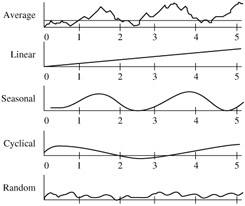
Figure 6.1: Sample trends

CORRELATION COEFFICIENT

The correlation coefficient determines how well the data fits the straight line. It is represented by the letter "r" and its values range from +1.0 (perfect positive correlation) to -1.0 (perfect negative correlation). A coefficient of zero (0) means that the data does not follow the line at all. A coefficient of one (1) means that all of the data points lie on the line.

Example:

A freight forwarder finds that an increasing amount of railroad boxcars are shipped empty from West to East every month. Determine the degree of correlation between the returning railroad boxcars using the monthly report shown next.

Sample Data

January

February

March

April

May

X:

1

2

3

4

5

Y:

25 Cars

28 Cars

30 Cars

32 Cars

40 Cars

Solution

?x

=

15

?x 2

=

55

?y

=

155

?y 2

=

4,933

?xy

=

499

n

=

5


CURVE FITTING

Curve fitting is a method for mathematically describing the relationship between two variables. The equation of...

UNLIMITED FREE
ACCESS
TO THE WORLD'S BEST IDEAS

SUBMIT
Already a GlobalSpec user? Log in.

This is embarrasing...

An error occurred while processing the form. Please try again in a few minutes.

Customize Your GlobalSpec Experience

Category: Rail Services
Finish!
Privacy Policy

This is embarrasing...

An error occurred while processing the form. Please try again in a few minutes.