Quantitative Measurements for Logistics

Logistics often involves collecting and processing data. Statistics are used to make that data useful for decision making. Assembling that data into meaningful terms often requires the use of statistical analysis. Statistics can be used to check the "goodness of fit," which is how well the data matches a particular set of rules. Reliability data for complex systems generally prescribe logarithmic trends. However, other distributions such as Linear (straight line), Gaussian (normal), Exponential, and Weibull also describe certain parameters of logistics.
Logistics data distributions can be classified as being either of the following types of variables:
Continuous: Can take any value along an interval.
Discrete: Certain values along an interval.
Statistics can be either of the following:
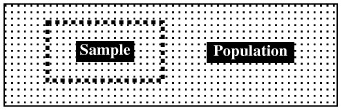
Descriptive: ( Tabular/Graphical/Numerical) Describes an entire data population.
Inferential: ( Estimation/Hypothesis Testing) Inferences about data based on a sample.

The following describes statistics data in terms of:
Percentiles: 100 equal parts each representing 1% of the observations.
Quartiles: 4 equal parts each representing 25% of the observations.
Deciles: 10 equal parts each representing 10% of the observations.
| First Decile: | (Lower) | 10 th percentile |
| First Quartile: | (Lower) | 25 th percentile |
| Second Quartile: | (Middle) | 50 th percentile (median) |
| Third Quartile: | (Upper) | 75 th percentile |
| Ninth Decile: | (Upper) | 90 th percentile |
A grouping of data (population or sample) is measured by location:
Median: The middle value of ordered data if n is odd or the mean of the two middle values if