Quantitative Measurements for Logistics

Determining needed spare parts and accurately forecasting spares quantities is difficult because future demands cannot be predicted with certainty. Spare parts models use historical data and then incorporate factors that adjust the data for any new or different technologies in the analyzed items. The following must be taken into consideration when calculating the quantity of required spare parts:
Economics of procurement and storage
Probability of item being needed
Quantity of the items used
Reliability of spared item
Mission criticality
| Sample Data | |
|---|---|
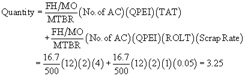
| Mean Time Between Removals (MTBR) | = 500 |
| Flight Hours/Month (FH/MO) | = 16.7 |
| Quantity per End Item (QPEI) | = 2 |
| Reorder Lead Time (ROLT) | = 1.0 Days |
| Turn Around Time (TAT) | = 4.0 Days |
| Number of Aircraft (AC) | = 12 |
| Number of Spare LRUs | = 3 |
| Scrap Rate | = 0.05 |
Many systems or components may be repairable by design; that is, when they fail, they can be restored to a Ready For Issue ( RFI) condition. When they are repaired they do not create a demand for a newly manufactured spare. However, a spare is required until that part is restored and resupplied through the logistics pipeline. A sample formula for calculating the quantity of repairable spare parts is:
Non-repairable items are those that cannot be repaired, either because of design, physical attribute, or economics. These items are either discarded (scrapped) at failure, or returned back to the manufacturer or supply system through a reverse logistics process (see Appendix D). They must...