Quantitative Measurements for Logistics

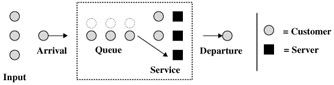
Queuing Theory is the theoretical study (expressed in mathematical terms) of waiting lines, which require arrival at random intervals and servicing in a variable amount of time. It analyzes the number of waiting lines, number of servers, average wait time, number of queues or lines, and probability of increasing or decreasing queue times. Queuing Theory can be used to analyze the capacity of maintenance centers by determining how fast parts will/should arrive and how quickly they will/should be serviced.
Queuing Theory is primarily concerned with processes, which have random arrivals, as well as the servicing that has random processing times. There are usually costs associated with waiting lines such as:
Adding more service facilities
Holding costs of inventory
People turning away
Work stations idle
Queuing Theory provides measures such as
Optimum number of service stations (work stations)
Expected number of people or objects in line
Expected waiting time of the arrivals
Idle time of service station
Queuing Theory is used for relatively simple situations whereas Simulation is used for more complex waiting line problems. Many combinations of situations may be calculated using Queuing Theory, including
Arrivals and services occurring following a given time schedule
Arrivals coming randomly from an infinite universe where
There is one service facility
There are multiple facilities
Arrivals coming from a finite population where
There is one service facility
There are multiple facilities
The following assumptions must be made when using the following Queuing Theory formulas:
A Poisson...