F. E. Nathanson
J. P. Reilly
This chapter reviews the basic forms of the radar equation and the variations needed to calculate the performance of a radar that is attempting to detect targets masked by the basic thermal noise of the radar receiver. Subsequently this development is extended to cover a general environment, which includes the multitude of superfluous returns that often exceed the basic receiver noise. These returns include electronic countermeasures, friendly interference, sky noise, and the backscatter from atmospheric effects, land, seas, and chaff.
2.1 General Radar Range Equation
The following general radar equation for pulse radars shown includes a larger number of parameters than is commonly used in current radar texts by Barton [39], Blake [75], and Skolnik [671], The separation of certain loss terms from the basic parameters facilitates rewriting the equations for the various external environments. The loss terms in this book are less than unity or are subtracted from the numerator when the equation is expressed in decibel form. The backscattered power received from a target of radar cross section ? t at the first mixer or preamplifier can be written
| (2.1) | 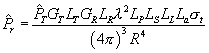
|
where  is peak received power.
Before elaborating on the terms of this equation, it is useful to convert the received power  to the minimum detectable received power S min and to rewrite the equation in terms of the detection range R for a pulse radar. Then
| (2.2) | 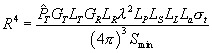
|
| where R = | the detection range of the desired... |
Copyright Marvin N. Cohen, Allan J. Nathanson, Lila H. Nathanson, Janice N. smith, J. Patr 1999 under license agreement with Books24x7

 TABLE OF CONTENTS