Radar Design Principles: Signal Processing and the Environment, Second Edition

F. E. Nathanson
J. P. Reilly
Backscatter from the surface of the sea limits the performance of radar surveillance and missile guidance for airborne, shipboard, and coastal early warning and defense systems. The following three sections provide models of the normalized radar power return from the sea as a function of frequency, polarization, grazing angle, and aspect with respect to the primary wind and sea condition. The statistics of these signals are given in Secs. 7.5, 7.6, and 7.7.
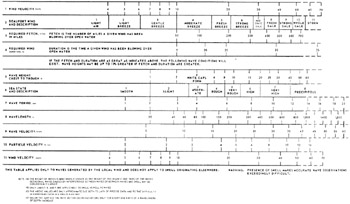
The general relationships between the wind and the surface conditions of the sea are given in Fig. 7.1. This figure defines sea state as well as would seem appropriate to subsequent discussions. Combined conditions at any given time or place may vary considerably from this chart because of the wind history or geographical factors. Note that Beaufort sea state [item (2) in the table] is not the same as the hydrographic sea state [item (6)]. The latter is appropriate for radar problems and is used in the following discussions.
To select radar parameters for operating near or on the sea, the relative probabilities of specific conditions of wind speed and sea state are needed. Severe storms degrade almost any radar system performance, but they rarely occur. Figure 7.2 gives worldwide probabilities of wind speed, derived by Long et al.