Radar Design Principles: Signal Processing and the Environment, Second Edition

For surface clutter (sea, land, or ice) the term ? 0 is used to represent the normalized mean (or median) reflectivity from an area on the surface of the earth illuminated by a radar. In some references, the term ? is used. The value is constant only for a given angle, carrier frequency, sea state, wind direction polarization, and even pulse length. To a first approximation the illuminated area is A = R ? 2 ? R for small grazing angles ( ?), narrow beamwidths and the peak antenna gain directed at the center of this clutter cell. R is the range from the radar to this cell, ? 2 is the two-way azimuth beamwidth, and ?R is the range resolution given by c ?/2 for noncoded pulses, or by the 3-dB resolution of a coded or compressed pulse. For better accuracy the effective pulse duration ?' from Chap. 2 may be used. There is at least a 3-dB standard deviation in almost all values of ? 0 whether they are experimental or theoretical. This uncertainty is expanded in later sections.
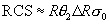
The clutter cross section in a resolution cell can be approximated by
| (7.1) | |
for small beamwidths and low grazing angles. Note that forward scatter is not explicitly taken into account, but is included in virtually all reported values of ? 0. The term is dimensionless and is...