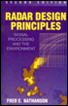
Radar Design Principles: Signal Processing and the Environment, Second Edition
The first seven chapters explored the concepts of detection, display, and target and clutter reflectivity that are common to many forms of radar processing. With proper interpretation these concepts are applicable to the various waveforms and signal processors to be discussed in the following seven chapters.
This chapter includes some of the general principles of waveform and processor design. The choice of transmit waveform and of the corresponding receiver configurations involves two separable design problems. The waveform must be chosen to optimize performance in some total environment. The limitations are generally external to the radar though restrictions may be imposed by the type of transmitter or antenna. The currently accepted belief that there is no universal waveform is not surprising in light of the wide variety of waveforms used for electrical communication, a subject that has had over 100 years of intensive study. On the other hand, the inability to find a best waveform is not an excuse for failure to search for locally optimum waveforms for specific radar tasks and environments.
The design of the radar processors (the hardware) is somewhat separable since there are generally two or more ways to design a near-optimum processor for a given waveform. Cost, complexity, and reliability rather than physical realizability are generally the bounds on processor design. Practical signal processors with less than a 2-dB deviation from maximum efficiency have been constructed for virtually all waveforms.
This chapter introduces the subject of waveform design with the now standard range-Doppler...