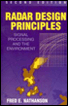
Radar Design Principles: Signal Processing and the Environment, Second Edition
Chapter 11: Pulse Doppler and Burst Waveforms

11.1 Terminology and General Assumptions

It is now generally accepted that the use of a pulse-train waveform is virtually a necessity to detect small airborne targets in a land clutter background. [1] The processing can take the form of the classical pulse Doppler described here, a sophisticated MTI (Chap. 9), or a moving target detector (MTD) (Chap. 14).

A pulse Doppler radar combines the range-discrimination capability of pulse radar with the frequency discrimination capability of CW radar by using a coherent pulse train, i.e., a train of pulses that are samples of a single unmodulated sine wave. For a fixed repetition rate, the spectrum consists of a set of lines with spacing equal to the repetition frequency. When a coherent pulse train is reflected by a moving object, the lines of the spectrum are Doppler frequency shifted an amount proportional to the object's radial velocity. When a number of objects with different velocities are present, the resultant echo is a superposition of a corresponding number of pulse trains, each with its own Doppler shift. A range gate is used to select only those pulse trains coincident in time (within a pulse width) with the pulse-train echoes from the target. A narrow-band filter following the range gate often selects only a single spectral line corresponding to a particular Doppler shift, thus attenuating all those trains that pass the range gate but do not have the proper Doppler shift.

Burst waveforms may be considered a special case of pulse...

UNLIMITED FREE
ACCESS
TO THE WORLD'S BEST IDEAS

SUBMIT
Already a GlobalSpec user? Log in.

This is embarrasing...

An error occurred while processing the form. Please try again in a few minutes.

Customize Your GlobalSpec Experience

Category: Pulse Transformers
Finish!
Privacy Policy

This is embarrasing...

An error occurred while processing the form. Please try again in a few minutes.