Radar Design Principles: Signal Processing and the Environment, Second Edition
F. E. Nathanson
J. P. Reilly
The radar range equation expresses the range at which a target may be detected with a given probability by a radar having a given set of parameters. This equation includes the target's radar cross section (RCS), which is a measure of the proportion of the incident energy reflected back to the radar. [1] This returned energy varies with a multitude of parameters such as transmitted wavelength, target geometry, orientation, and reflectivity.
The radar cross section of an object is proportional to the far-field ratio of reflected to incident power density, that is
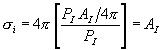
Using this definition, consider the RCS of a perfectly conducting isotropic scatterer. The power intercepted by the radiator is the product of the incident power density P I and its geometric projected area A I. The power of an isotropic scatterer is uniformly distributed over 4 ? steradians, in which case
| (5.1) | |
Thus, the RCS of such an isotropic reflector is its geometric projected area. The RCS of any reflector may be thought of as the projected area of an equivalent isotropic reflector which would return the same power per unit solid angle. A reflector that concentrates its reflected energy over a limited angular direction may have an RCS for that direction that exceeds its projected area. This indicates that, when specifying cross sections, one must also specify the aspect of the target. The RCS is also dependent on other parameters...