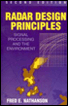
Radar Design Principles: Signal Processing and the Environment, Second Edition
The Doppler spectrum of sea backscatter is more complex than what was previously believed. One explanation for the frequency spread of signals returned from sea clutter is that the distribution of radial velocities of the scatterers causes a distribution of Doppler frequencies. These scatterers may be either individual wavelets, wind-blown spray and foam at higher sea states, gravity waves and swell, or any combination of these. When the spread of the velocity distribution increases, such as when the surface of the sea becomes more agitated, the clutter spectrum also broadens.
The width of the velocity spectrum ? v may be related to the width of the Doppler spectrum ? f by the familiar expression
| (7.2) | |
where ? is the transmitted wavelength. Spectrum measurements are expressed in velocity rather than frequency units so that the results of investigations at various frequencies can be compared.
If the scattering mechanism is the same for all wavelengths, then multiplication of the Doppler spread by ?/2 should make spectrum measurements (expressed in velocity units) at different frequencies independent of frequency. Experimental observations from a number of different investigators are illustrated in Figs. 7.5 and 7.6. The carrier frequencies used ranged from 220 MHz to 9.5 GHz. (Most measurements were made at the higher frequencies.) Figure 7.5 presents the data of early experimenters who analyzed the clutter spectrum prior to envelope detection, whereas Fig.