Radar Design Principles: Signal Processing and the Environment, Second Edition

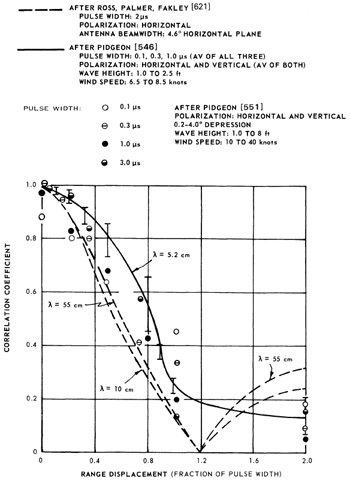
The spatial correlation of sea clutter is defined as the cross correlation between the signals returned from two separate patches of the sea in the radial dimension. The time interval separating the measurement of these two signals is assumed to be so small that there is negligible time decorrelation. At 5.7 GHz, Pidgeon [546] noted that the separation necessary to achieve independence was about the distance corresponding to a pulse length. Figure 7.10 illustrates the spatial correlation function versus radial displacement in units of pulse length. Included in Fig. 7.10 are spatial correlation functions replotted from several sources. The pulse length dependence is evident at UHF, S-band, and C-band. Further measurements are required to determine better if the returns are partially decorrelated in range for very short pulses (<0.1 ?s) and narrow beamwidths, in which case the sea echo is resolved into individual waves (see Sec. 7.7).
In the measurement of the mean backscatter ? 0 from the sea, the number of independent clutter samples determines the accuracy of the estimated mean value of the backscatter. It has been shown in Sec. 7.5 that the sea return from a given cell is correlated for a period of many milliseconds and that to achieve accuracies of about 1 dB in the estimation of the mean requires measurement times in excess of 1 s for a stationary radar. Airborne radar measurements of clutter acquire...