Radar Design Principles: Signal Processing and the Environment, Second Edition

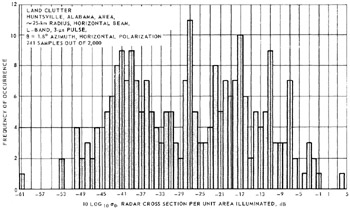
The description of land clutter return has been divided into types of terrain having backscatter coefficients that differ by a spread of about 15 dB between cities and cultivated land. If a surface radar is placed near a city a composite terrain return will be obtained. An example of this placement is shown in Fig. 7.24 [176]. The radar used to obtain these data was located near Huntsville, Alabama; the survey was made with an L-band radar using a 3- ?s pulse and a 1.8 azimuth beam width. The figure was drawn for 241 of the returns from the strongest cells; the Huntsville city area gave the group of higher values of ? 0, and the hilly countryside showed another distribution centered around ? 0 = -40 dB. It appears from the report that over 2000 cells were observed, but that about 90 percent of the cells were masked by the terrain and hence gave negligible return. The median value ? m cannot be determined, and even the 84-percent value is probably indeterminate. Boothe [83] later fit this type of data to a Weibull distribution. The false alarm probability for a simple search radar, owing to clutter returns at this location, is determined by the relatively few large clutter cells unless a clutter mapping system is used to inhibit the returns from the city area. This is discussed in Chap. 14.