Serial ATA Storage Architecture and Applications
For Serial ATA to be an attractive replacement for parallel ATA in the mobile market segment, it is essential that it have power consumption and management attributes suitable for the mobile environment. Thanks to the early involvement of mobile-savvy stakeholders, the interface was designed from inception with the needs of mobile environments in mind. The power management facilities defined for Serial ATA complement the power management capabilities of the ATA command set. While the ATA command set relies primarily on reducing the power of the attached device, by spinning down the disk, for example, Serial ATA applies power management techniques to the interface itself.
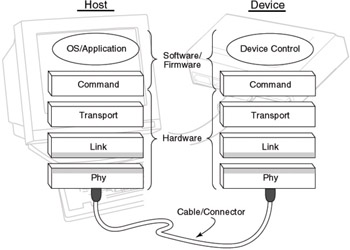
As Figure 8.1 indicates, power management is a cooperative effort primarily involving a portion of both the PHY and Link layers.
Interface power management not only has the obvious benefits of reducing power consumption for mobile systems that are sensitive to battery life, but also provides other benefits that make it attractive for desktops, appliances, and servers.
Even for workloads that are extremely disk intensive, the amount of time that the interface actually spends transferring data is generally a very small fraction of the elapsed time. The serial interface is always active, even when no payload data is to be transmitted. The interface must maintain lock, and to accommodate this, null characters are transmitted in place of actual payload data during idle times. With the duty cycle generally...