Serial ATA Storage Architecture and Applications
Although Serial ATA was developed so that you wouldn t need new software written specifically to support it, Serial ATA provides several-new capabilities that newly written software can utilize to get the most out of the interface and attached devices. Much of the Serial ATA behavior is an emulation of the parallel ATA behavior for the purpose of ensuring legacy software compatibility, and some of the emulated behavior is accommodated purely for such legacy software support and serves no real purpose in Serial ATA. Additionally, Serial ATA provides some capabilities that have no equivalent in parallel ATA. New software may elect to make use of such capabilities.
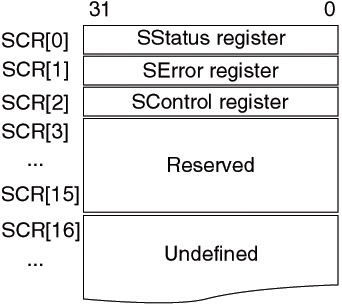
As mentioned, Serial ATA provides some capabilities that have no equivalent in parallel ATA. To provide a uniform means for host software to make use of these capabilities, a set of new registers was defined for them. The existing taskfile registers were already fully defined by the existing parallel ATA standards, and to avoid creating conflicts with that standard, Serial ATA added a new set of registers to the existing taskfile registers. These new registers are usually referred to in Serial ATA as superset registers since they provide new functionality not provided in parallel ATA. Figure 15.1 shows a map of the superset registers that are defined in Serial ATA 1.0; additional registers are defined in the Serial ATA II specification. The registers are referred to generically as status and control registers (SRCs).
The superset...