Serial ATA Storage Architecture and Applications
This chapter looks at Serial ATA from the system level. Servers offer more creative ways to employ Serial ATA beyond the basic PC use case.We start with a look at a basic server with a RAID card and internal devices, then we review several external storage use cases, including a bit of performance estimation, and conclude with a discussion of ways to eliminate single points of failure in systems designed for high availability.
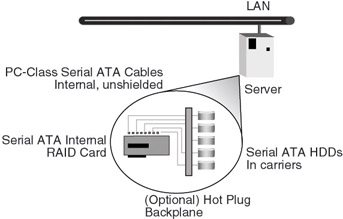
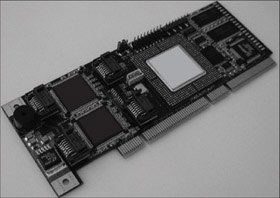
Very basic servers usually consist of a motherboard, a network interface, and one or two disk drives providing direct attachment storage (DAS). These servers do not offer much in the way of protection against failures. RAID is frequently added to these basic servers to provide some protection against drive failure as well as a performance boost. A basic server use case, including a RAID card, is shown in Figure 14.1. The example product shown in Figure 14.2 is a RAID card that includes four Serial ATA ports, couple of 2-port controllers, ECC memory, a combination I/O processor, a PCI bridge, and a modest price tag. This product works in PCI-33 or PCI-66 slots. It s simple, reasonably priced, and very effective in controlling entry-level RAID in basic servers with DAS.
This use case really makes best possible use of high volume standard designs and shows how well PC-class Serial ATA product works in basic servers. The...