Serial ATA Storage Architecture and Applications
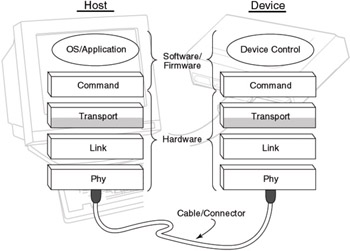
The Transport layer is the portion of the interface that is responsible for delivering and acting on the data structures that can be communicated between the host and the device. In addition to defining the format and function of all the data structures, the transport layer defines the protocol describing the legal sequences of such data structures. Because the layer defines the form and function of the data structures as well as the legal sequences of such data structures, we ve divided the Transport layer description into two chapters, with this chapter focusing on the form and function of the data structures and the following chapter focusing on the protocol for describing the legal sequences of such data structures being exchanged. Figure 11.1 indicates the layer of the architecture covered in this chapter.
Like most modern serial interfaces, Serial ATA is a packetized interface where commands and data that are passed between the host and device are formed into packets prior to transmission. In Serial ATA, these units of information exchange are not referred to as packets, like they are in networking parlance, but are called frames instead. A frame is the unit of data or information that can be exchanged between the host and device, and the Link layer protocol described in Chapter 10 provides the mechanisms required for delivering such frames.While the Link layer is responsible for delivering a frame, the Transport layer is responsible for...