Signal Detection and Estimation, Second Edition

Packed with over 2,100 equations, 230 figures and 183 problems, this authoritative resource helps you apply the material to projects in the field involving signal processing, radar, and communications.
 TABLE OF CONTENTS
 In Chapter 5, we considered the problem of detection theory, where the receiver receives a noisy version of a signal and decides which hypothesis is true among the M possible hypotheses. In the binary case, the receiver had to decide between the null hypothesis H 0 and the alternate hypothesis H 1.
In this chapter, we assume that the receiver has made a decision in favor of the true hypothesis, but some parameter associated with the signal may not be known. The goal is to estimate those parameters in an optimum fashion based on a finite number of samples of the signal.
Let Y 1, Y 2, , Y K be K independent and identically distributed samples of a random variable Y, with some density function depending on an unknown parameter ?. Let y 1, y 2, , y K be the corresponding values of samples Y 1, Y 2, , Y K and g( Y 1, Y 2, , Y K), a function (a statistic) of the samples used to estimate the parameter ?. We call

the estimator of ?. The value that the statistic assumes is called the estimate of ? and is equal to 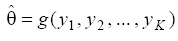 . In order to avoid any confusion between a random variable and its value, it should be noted that
  , the estimate of