Signal Detection and Estimation, Second Edition

Packed with over 2,100 equations, 230 figures and 183 problems, this authoritative resource helps you apply the material to projects in the field involving signal processing, radar, and communications.
 TABLE OF CONTENTS
 In our daily life, we are constantly making decisions. Given some hypotheses, a criterion is selected, upon which a decision has to be made. For example, in engineering, when there is a radar signal detection problem, the returned signal is observed and a decision is made as to whether a target is present or absent. In a digital communication system, a string of zeros and ones may be transmitted over some medium. At the receiver, the received signals representing the zeros and ones are corrupted in the medium by some additive noise and by the receiver noise. The receiver does not know which signal represents a zero and which signal represents a one, but must make a decision as to whether the received signals represent zeros or ones. The process that the receiver undertakes in selecting a decision rule falls under the theory of signal detection.
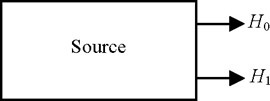
The situation above may be described by a source emitting two possible outputs at various instants of time. The outputs are referred to as hypotheses. The null hypothesis H 0 represents a zero (target not present) while the alternate hypothesis H 1 represents a one (target present), as shown in Figure 5.1.
Each hypothesis corresponds to one or more observations that are represented by random variables. Based on the observation values of these random variables, the receiver decides which hypothesis ( H 0 or H 1) is true. Assume that the...