Signal Detection and Estimation, Second Edition

Packed with over 2,100 equations, 230 figures and 183 problems, this authoritative resource helps you apply the material to projects in the field involving signal processing, radar, and communications.
 TABLE OF CONTENTS
 The function s( t, ?) is now a nonlinear function in ?. Again, ? may be random or nonrandom.
Let { ? k( t)} be a set of K orthonormal basis functions. Since we require an infinite number of basis functions to represent Y( t), we approximate the received signal Y( t) as

where
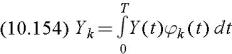
Substituting (10.135) into (10.154), we have

where
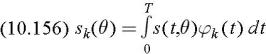
The Y k is a statistically independent Gaussian random variable with mean s k( ?) and variance N 0/2. Thus, the likelihood function, from (6.2), is

As K ? ?, (10.157) is not well defined. In fact,

Since the likelihood function is not affected if it is divided by any function that does not depend on ?, we avoid the convergence difficulty of (10.156) by dividing L( ?) by

Consequently, we define ? ?[ y, ?] as

The ML estimate is the value of ? for which ? k[ Y, ?] is maximum. Using Parseval's theorem and the fact that 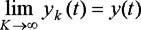 and
and  , we obtain

and

Using (10.161) and (10.162), and taking the logarithm as K ? ?, the likelihood function is

To obtain the ML estimate  , which maximizes the likelihood function, we differentiate (10.163) with respect to ? and set the result equal to zero. We find that the ML estimate