Signal Detection and Estimation, Second Edition
Packed with over 2,100 equations, 230 figures and 183 problems, this authoritative resource helps you apply the material to projects in the field involving signal processing, radar, and communications.
 TABLE OF CONTENTS
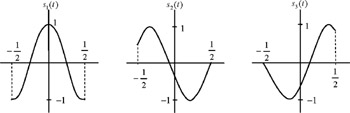
 | 10.1 | A signal source generates signals as shown in Figure P10.1. The signals are expressed as s 1( t) = cos(2 ? t) rect( t), s 2( t) = cos[2 ? t + (2 ?/3)] rect( t), and s 3( t) = cos[2 ? t ? (2 ?/3)]rect( t).
|
| 10.2 | A rectangular pulse of known amplitude A is transmitted starting at time instant t 0 with probability 1/2. The duration T of the pulse is a random variable uniformly distributed over the interval [ T 1, T 2]. The additive noise to the pulse is white Gaussian with mean zero and variance N 0/2.
|
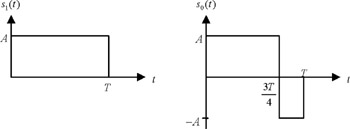
| 10.3 | Consider the general binary detection problem  where s 1( t) and s 0( t) are as shown in Figure P10.3, and W( t) is a white Gaussian noise with mean zero and power spectral density N 0 /2.
|
| 10.4 | In a binary detection problem, the transmitted signal under... |