Signal Detection and Estimation, Second Edition
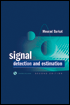
Packed with over 2,100 equations, 230 figures and 183 problems, this authoritative resource helps you apply the material to projects in the field involving signal processing, radar, and communications.
 TABLE OF CONTENTS
 In Chapters 1 and 3, we presented the fundamentals of probability theory and stochastic processes. In Chapters 5 and 6, we developed the basic principles needed for solving decision and estimation problems. The observations considered were represented by random variables. In Chapter 7, we presented the orthogonality principle and its application in the optimum linear mean-square estimation. In Chapter 8, we presented some mathematical principles, such as Gram-Schmidt orthogonalization procedure, diagonalization of a matrix and similarity transformation, integral equations, and generalized Fourier series. The concept of generalized Fourier series was then used to represent random processes by an orthogonal series expansion, referred to as the Karhunen-Lo ve expansion. Chapter 8 gave us the basic mathematical background for Chapters 9 and 10. In Chapter 9, we covered the general detection Gaussian problem.
In this chapter, we extend the concepts of decision and estimation problems to time varying waveforms. If a signal is transmitted, then the received waveform is composed of the transmitted signal and an additive noise process. If no signal is transmitted, then the received waveform is noise only. The goal is to design an optimum receiver (detector) according to some criterion. In Section 10.2, we discuss the general and simple binary detection of known signals corrupted by an additive white Gaussian noise process with mean zero and power spectral density N 0/2. The received waveforms are observed over the interval of time t ? [0, T].
In Section 10.3, we extend the concepts of binary...