Signal Detection and Estimation, Second Edition

Packed with over 2,100 equations, 230 figures and 183 problems, this authoritative resource helps you apply the material to projects in the field involving signal processing, radar, and communications.
 TABLE OF CONTENTS
 In Chapter 2, we discussed the Gaussian random variable. In Sections 3.4.4 and 8.4.1, we discussed Gaussian random processes. Due to the wide use of the Gaussian process, we formulate the general Gaussian problem in Section 9.2. In Section 9.3, we cover the general Gaussian problem with equal covariance matrix under either hypothesis H 1 or H 0. For nondiagonal covariance matrices, we use an orthogonal transformation into a new coordinate system so that the matrix is diagonalized. In Section 9.4, we also solve the general Gaussian binary hypothesis problems but with mean vectors equal under both hypotheses. In Section 9.5, we consider symmetric hypotheses and obtain the likelihood ratio test (LRT).
In this section, we formulate the general Gaussian problem for binary hypothesis testing. Consider the hypotheses
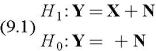
where the vector observation Y, the signal vector X, and the noise vector N are given by
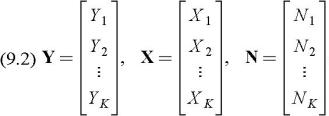
The noise components are Gaussian random variables. By definition, a hypothesis testing problem is called a general Gaussian problem if the conditional density function f Y H j ( y H j) for all j is a Gaussian density function. Similarly, an estimation problem is called a general Gaussian problem if the conditional density function f y ? ( y ?) has a Gaussian density for all ?, where ? is the parameter to be estimated.
Consider the binary hypothesis testing problem...