Signal Detection and Estimation, Second Edition

Packed with over 2,100 equations, 230 figures and 183 problems, this authoritative resource helps you apply the material to projects in the field involving signal processing, radar, and communications.
 TABLE OF CONTENTS
 In Chapter 6, we studied some techniques for parameter estimation in some optimum way, based on a finite number of samples of the signal. In this section, we consider parameter estimation of the signal, but in the presence of an additive white Gaussian noise process with mean zero and power spectral density N 0 /2. The received waveform is of the form

where ? is the unknown parameter to be estimated and s( t) is a deterministic signal with energy E. The parameter ? may be either random or nonrandom. If it is random, we use Bayes estimation; otherwise, we use the maximum likelihood estimation. We assume that s( t, ?), which is a mapping of the parameter ? into a time function, is linear. That is, the superposition principle holds, such that

The estimator of the above-mentioned problem is linear, as will be shown later, and thus we refer to the problem as a linear estimation problem.
Systems that use linear mappings are known as linear signaling or linear modulation systems. For such signaling, the received waveform may be expressed as

We now consider the cases where the parameter is nonrandom and random.
In this case, ? is a nonrandom parameter. Y( t) may be expressed in a series of orthonormal functions, such that

where
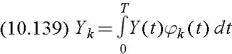
and the function ? k forms a complete set of...