Standard Handbook for Electrical Engineers, Fourteenth Edition

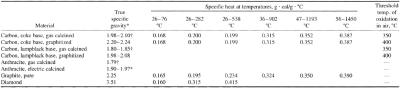
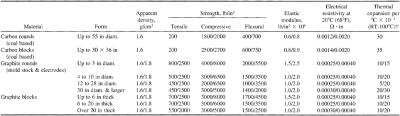
Carbon occurs in two forms, amorphous and crystalline. The crystalline forms include diamond and graphite. The amorphous forms include charcoal, coke, and carbon black; coal is an impure variety of amorphous carbon. Some of the typical properties of carbon and electrographites manufactured from these carbons are listed in Tables 4-38 and 4-39.
| |
| *As measured by pycnometer. Dependent on source and degree of calcination. |
| |
| Note: With grain, properties are listed as maximum/minimum values. 1 in=2.54 cm; 1 lb/in 2=6.895 kPa. *Characteristics shown are typical values and will differ with individual grades and manufacturers. RT=room temperature. |
Most carbon used for electrical purposes is made from a mixture of powdered carbon and/or graphite (such as lampblack and petroleum coke) and binders (such as pitch and resins), which are mixed into a homogeneous mass, extruded or molded, and then baked. When the mixture is baked to approximately 900 C with the air excluded, the volatile part of the binding material is driven off and the remaining binder is carbonized. The resulting product can be converted into electrographite by furnacing it in the absence of oxygen to a temperature of not less than 2200 C, usually higher.
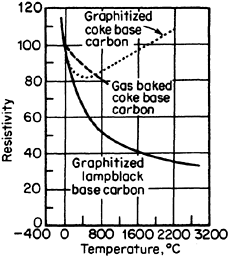
Carbon exhibits an increasing electrical and thermal conductivity with rising temperature. Graphite can exhibit a complicated change in electrical conductivity with...