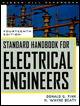
Standard Handbook for Electrical Engineers, Fourteenth Edition
W.Bruce Dietzman
Project Engineering Manager, TXU Electric and Gas; Senior Member, IEEE; Chair, IEEE/PES Substations Committee
Philip C.Bolin
GIS Product Manager, Mitsubishi Electric Power Products, Inc., Member, IEEE; Chair, IEEE/PES Gas-Insulated Substations Subcommittee; Member, CIGRE Working Group 23.10. GIS
Joseph Basilesco
President, Basilesco Consultants; Life Member, IEEE; Member, Power Systems Communications Committee; Member, CIGRE
Transmission and Distribution Systems. In large, modern ac power systems, the transmission and distribution systems function to deliver bulk power from generating sources to users at the load centers. Transmission systems generally include generation switchyards, interconnecting transmission lines, autotransformers, switching stations, and step-down transformers. Distribution systems include primary distribution lines or networks, transformer banks, and secondary lines or networks, all of which serve the load area.
As an integral part of the transmission or distribution systems, the substation or switching station functions as a connection and switching point for generation sources, transmission or subtransmission lines, distribution feeders, and step-up and step-down transformers. The design objective for the substation is to provide as high a level of reliability and flexibility as possible while satisfying system requirements and minimizing total investment costs.
Voltage Levels. The selection of optimal system voltage levels depends on the load to be served and the distance between the generation source and the load. Many large power plants are located great distances from the load centers to address energy sources or fuel supplies, cooling methods, site costs and...