Standard Handbook for Electrical Engineers, Fourteenth Edition
Charles L.Amick
Professional Engineer; Lighting Consultant; Fellow, Illuminating
Engineering Society of North America (IESNA); Lighting
Certified, National Council on Qualifications for the Lighting
Professions; Member, U.S. National Committee of the
International Commission on Illumination; Member, National
Society of Professional Engineers
Includes some material from previous editions by Jack F.Parsons, Walter Sturrock, Karl A.Staley, and John A.Kaufman.
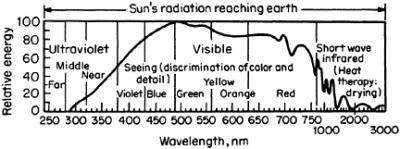
For the principal purposes of illumination design, light is defined as visually evaluated radiant energy. The visible energy radiated by light sources is found in a narrow band in the electromagnetic spectrum (Fig. 26 1) approximately from 380 to 770 nanometers (nm). By extension, the art and science of illumination also include the applications of ultraviolet and infrared radiation. The principles of measurement, methods of control, and fundamentals of lighting system and equipment design in these fields closely parallel those long established in lighting practice.
Luminous Flux. This is the time rate of flow of light. See Table 26 1. Radiant energy in the visible region of the spectrum varies in its ability to produce visual sensation, the variation depending upon the wavelength. The ratio of the luminous flux to the corresponding radiant flux is known as spectral luminous efficacy (formerly luminosity factor) and is expressed in lumens per watt (lm/W). This varies with wavelength, having a...