Standard Handbook for Electrical Engineers, Fourteenth Edition
James L.Kirtley, Jr.
Vice President and General Manager, Technology Division
SatCon Technology Corporation
This section deals with ac electric machines that convert mechanical power into electric power. With very few exceptions, these are wound-field synchronous machines, and thus the subject matter of this chapter deals exclusively with this class of machine.
Ac generators range in size from very modest machines rated at a few hundred watts to the largest electric machines built, with single machine ratings exceeding 1 GW.
It is the intent of this chapter to gain an understanding of the nature and operation of synchronous generators with application of such machines in mind. It is not intended to serve as a guide to design or manufacture.
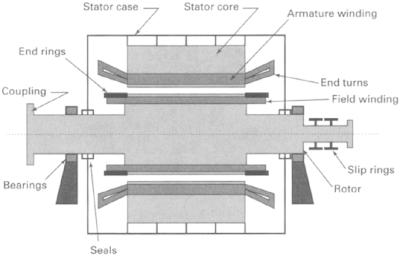
All synchronous generators consist of an armature, the power-handling ac winding, located on the stator of the machine (Fig. 7-1). The armature interacts with the field winding, which is typically a part of the rotor. The machine has a magnetic circuit comprising a ferromagnetic rotor and a stator structure made up of laminations of ferromagnetic steel sheet.
The armature winding is mounted in slots in the inner surface of the stator structure, which is generally referred to as the stator core. Generally, ac generators employ a polyphase armature winding; the most common number of phases is 3.
The rotor and stator (field and armature)...