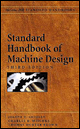
Standard Handbook of Machine Design, 3rd Edition
Part 4: POWER TRANSMISSION

Chapter 14: BELT DRIVES
Chapter 15: CHAIN DRIVES
Chapter 16: COUPLINGS
Chapter 17: SHAFTS

Wolfram Funk, Prof. Dr.-Ing.

Fachbereich Maschinenbau
Fachgebiet Maschinenelemente und Getriebetechnik
Universit t der Bundeswehr Hamburg
Hamburg, Germany

NOMENCLATURE

A

Cross section

b

Width

c ?

ngular factor

c B

Service factor

d 1

Diameter of driving pulley

d 2

Diameter of driven pulley

e

Center distance

E

Modulus of elasticity

F

Force

f b

Bending frequency

l

Datum length of flexible connector

M

Torque

n

Speed

P

Power

q

Mass per length

r

Radius

s

Belt thickness

t

Pitch

v

Velocity

z

Number

?

Included angle

?

Angle of wrap

?

Elongation (strain)

Coefficient of friction

?

Efficiency

?

Slip

?

Specific mass

?

Stress

Indices

1

Driving

2

Driven

b

Bending

f

Centrifugal

max

Maximum

w

Effective

zul

Allowable

N

Nominal

14.1 GENERAL

Flexible-connector drives are simple devices used to transmit torques and rotational motions from one to another or to several other shafts, which would usually be parallel. Power is transmitted by a flexible element (flexible connector) placed on pulleys, which are mounted on these shafts to reduce peripheral forces. The transmission ratios of torques and speeds at the driving and driven pulleys are determined by the ratio of pulley diameters. Peripheral forces may be transmitted by either...

UNLIMITED FREE
ACCESS
TO THE WORLD'S BEST IDEAS

SUBMIT
Already a GlobalSpec user? Log in.

This is embarrasing...

An error occurred while processing the form. Please try again in a few minutes.

Customize Your GlobalSpec Experience

Category: Flat Belts
Finish!
Privacy Policy

This is embarrasing...

An error occurred while processing the form. Please try again in a few minutes.