Standard Handbook of Machine Design, 3rd Edition

Joseph E. Shigley
Professor Emeritus
The University of Michigan
Ann Arbor, Michigan
| A | Area, or a constant | |
| B | Constant | |
| C | Constant | |
| E | Modulus of elasticity | |
| e | Eccentricity | |
| F | Force | |
| G | Modulus of rigidity | |
| I | Second moment of area (Table A.1) | |
| K | Shape constant (Table 36.1), or second polar moment of area | |
| M | Bending moment | |
| P | Reduced load | |
| Q | Fictitious force | |
| R | Force reaction | |
| r | Ring radius | |
| | Centroidal ring radius | |
| T | Torsional moment | |
| U | Strain energy | |
| V | Shear force | |
| W | Resultant of a distributed load | |
| w | Unit distributed load | |
| X | Constant |
Methods of computing the stresses in curved beams for a variety of cross sections are included in this chapter. Rings and ring segments loaded normal to the plane of the ring are analyzed for a variety of loads and span angles, and formulas are given for bending moment, torsional moment, and deflection.
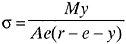
The distribution of stress in a curved member subjected to a bending moment in the plane of curvature is hyperbolic ([38.1], [38.2]) and is given by the equation
| (38.1) | |
where r = radius to centroidal axis
y = distance from neutral axis
e = shift in neutral axis due to curvature (as noted in Table 38.1)
Table 38.1: