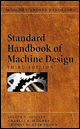
Standard Handbook of Machine Design, 3rd Edition
Chapter 39: PRESSURE CYLINDERS

Sachindranarayan Bhaduri, Ph.D.

Associate Professor
Mechanical and Industrial Engineering Department
The University of Texas at El Paso
El Paso, Texas

INTRODUCTION

The pressure vessels commonly used in industrial applications consist basically of a few closed shells of simple shape: spherical or cylindrical with hemispherical, conical, ellipsoidal, or flat ends. The shell components are joined together mostly by welding and riveting; sometimes they are bolted together using flanges.

Generally, the shell elements are axisymmetrical surfaces of revolution formed by rotation of a straight line or a plane curve known as a meridian or a generator about an axis of rotation. The plane containing the axis of rotation is called the meridional plane. The geometry of such simple shells is specified by the form of the midwall surface, usually two radii of curvature and the wall thickness at every point. The majority of pressure vessels are cylindrical.

In practice, the shell is considered thin if the wall thickness t is small in comparison with the circumferential radius of curvature R ? and the longitudinal radius of curvature R ?. If the ratio R ?/ t > 10, the shell is considered to be thin shell. This implies that the stresses developed in the shell wall by external loads can be considered to be uniformly distributed over the wall thickness. Many shells used in pressure-vessel construction are relatively thin (10 < R ?/ t < 500), with the associated uniform distribution of stresses throughout...

UNLIMITED FREE
ACCESS
TO THE WORLD'S BEST IDEAS

SUBMIT
Already a GlobalSpec user? Log in.

This is embarrasing...

An error occurred while processing the form. Please try again in a few minutes.

Customize Your GlobalSpec Experience

Category: Tube and Pipe Bending Machines
Finish!
Privacy Policy

This is embarrasing...

An error occurred while processing the form. Please try again in a few minutes.