Standard Handbook of Machine Design, 3rd Edition

Joseph E. Shigley
Professor Emeritus
The University of Michigan
Ann Arbor, Michigan
When forces are distributed over a line, an area, or a volume, it is often necessary to determine where the resultant force of such a system acts. To have the same effect, the resultant must act at the centroid of the system. The centroid of a system is a point at which a system of distributed forces may be considered concentrated with exactly the same effect.
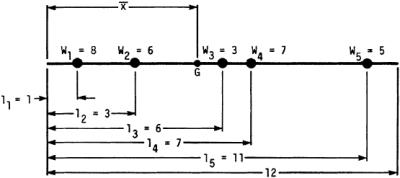
Figure A.1 shows four weights W 1 , W 2 , W 4 , and W 5 attached to a straight horizontal rod whose weight W 3 is shown acting at the center of the rod. The centroid of this weight or point group is located at G, which may also be called the center of gravity or the center of mass of the point group. The total weight of the group is
This weight, when multiplied by the centroidal distance
, must balance or cancel the sum of the individual weights multiplied by their respective distances from the left end. In other words,
or
A similar procedure can be used when the point groups are contained in an area such as Fig. A.2. The centroid of the group at G is now defined...