Steam Plant Operation, Eighth Edition
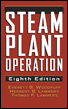
Packed with illustrations and fundamental descriptions, this definitive reference keeps readers current with the latest design methods of various systems and assists in all areas of steam plant operation.
 TABLE OF CONTENTS
 Pumps are used for many purposes and a variety of services: for general utility service, cooling water, boiler feed, and lubrication; with condensing water and sumps; as booster pumps, etc. There is a pump design best suited to each purpose and individual service.
Turbines and boilers have increased in size, requiring larger boiler feed pumps. Many of today s utility boilers operate above the super-critical pressure of 3206 psi. With increased pump reliability, many generating stations use fewer pumps, perhaps a single pump for each boiler-turbine unit. Steam-turbine-driven pumps are often used as compared with motor-driven pumps. The steam-turbine drive s advantages are (1) decreased electric power consumption, (2) ideal speed operation with the elimination of hydraulic couplings, and (3) exhaust steam that can be used to improve the station heat balance.
Although there are a variety of pumps found in a power plant, the basic steam power plant cycle includes a combination of a condensing and a feedwater heating cycle, and this requires a minimum of three pumps:
A condensate pump that transfers the condensate from the condenser hot well into the deaerator
A boiler feed pump that transfers feedwater from the feedwater heaters to the economizer or the boiler steam drum
A circulating water pump that provides cooling water through the condenser to condense the exhaust steam from the turbine
Pumps that are found in power plants come in a variety of sizes and designs that depend on the fluid and the service.