
λ/2 Optical Polarizers
Last Updated: April 1, 2025
Description
?/2 Optical Polarizers, also known as half-wave plates, are optical devices that manipulate the polarization state of light. They are designed to alter the polarization direction of an incoming light beam by a specific angle, typically 90 degrees. This is achieved by introducing a phase shift between the orthogonal polarization components of the light.
Working Principle
The working principle of ?/2 Optical Polarizers involves the use of birefringent materials, which have different refractive indices for different polarization directions. When light passes through a half-wave plate, the phase of one polarization component is delayed relative to the other by half a wavelength (?/2). This phase shift effectively rotates the polarization direction of the light. The ability to control the polarization state makes these polarizers useful in various optical systems, as they can be used to adjust the polarization to match the requirements of other optical components or to reduce unwanted reflections.
Applications
?/2 Optical Polarizers are widely used in applications where precise control of polarization is required. Specific examples include:
- Laser Systems: They are used to rotate the polarization of laser beams to optimize the performance of optical components such as beam splitters and mirrors.
- Optical Instrumentation: In scientific instruments, they help in controlling the polarization state for accurate measurements and analysis.
- Telecommunications: They are employed in fiber optic systems to manage polarization mode dispersion and improve signal quality.
Advantages over other Optical Polarizers
?/2 Optical Polarizers offer several advantages over other types of polarizers:
- Precision Control: They provide precise control over the polarization state, which is crucial in applications requiring high accuracy.
- Minimal Loss: Unlike some polarizers that absorb or reflect unwanted polarization, half-wave plates primarily alter the polarization direction with minimal loss of light intensity.
Limitations
Despite their advantages, ?/2 Optical Polarizers have certain limitations:
- Material Constraints: The performance is highly dependent on the quality and properties of the birefringent material used, which can limit their effectiveness at certain wavelengths.
- Wavelength Specificity: They are typically designed for specific wavelengths, and their performance can degrade outside these ranges.
Considerations
When considering the use of ?/2 Optical Polarizers, several factors should be taken into account:
- Initial Costs: The cost can vary significantly depending on the material and precision required.
- Durability: The durability is influenced by the environmental conditions and the quality of the material.
- Accuracy: High precision in manufacturing is necessary to ensure accurate polarization control.
- Maintenance Costs: Regular maintenance may be required to ensure optimal performance, especially in high-precision applications.
from Newport MKS
The 10RP52-3B Achromatic Quartz-MgF2 Zero-Order Wave Plate consists of two different birefringent crystals: crystalline quartz and magnesium fluoride (MgF2). Enclosed in a 1 inch (25.4 mm) housing this 18 mm aperture zero-order wave plate has λ/2 retardation over a 1000 to 1600 nm wavelength... [See More]
- Surface Flatness: λ/2
- Wavelength Range: 1000 to 1600
- Optical Polarizer: Waveplate / Retardation Plate
- Clear Aperture: 18

from CASTECH, Inc.
• High Polarization Purity. • Wide Wavelength Range. • High UV Transmission. • Available with two, one or no escape ports for extra power capacity. • Suitable for high power applications [See More]
- Surface Flatness: λ/2
- Wavelength Range: 350 to 2300
- Optical Polarizer: Calcite Polarizer
- Clear Aperture: 10

from CASTECH, Inc.
• High Polarization Purity. • Wide Wavelength Range. • High Total Transmission [See More]
- Surface Flatness: λ/2
- Wavelength Range: 350 to 2300
- Optical Polarizer: Calcite Polarizer
- Clear Aperture: 10

from Arcoptix S.A
Liquid Crystal twisted nematic polarization rotator (TN cell) is very useful when one wants to rotate the orientation of a linear polarization by a fix amount of typically 45 ° or 90 °. When light is traversing LC twisted nematic cell its polarization follows the rotation of the molecules... [See More]
- Surface Flatness: λ/2; λ/4
- Wavelength Range: 350 to 1800
- Optical Polarizer: Polarization Rotator
- Operating Temperature: 15 to 35

from Tower Optical Corporation
Tower ’s achromatic waveplate (AWP) is similar to a zero-order waveplate, which is made from two pieces of crystal quartz except that the AWP is composed of one piece of crystal quartz and one piece of magnesium fluoride, MgF2. Both of these materials are birefringent, however, by proper... [See More]
- Surface Flatness: λ/2; λ/4
- Wavelength Range: 465 to 1650
- Optical Polarizer: Waveplate / Retardation Plate
- Clear Aperture: 12
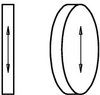
from Qioptiq
Made of crystal quartz. Antireflective coating (R < 0.2 % at central wavelength). Wavefront distortion: λ/8 (at 632.8 nm). Surface quality: 2 x 0.063 (20/10 scratch and dig). Parallelism better than 1". Retardation tolerance λ/500 (typical). Type S: Single plate (multiple order). [See More]
- Surface Flatness: λ/2; λ/4
- Polarizer Application: Infrared; Visible
- Optical Polarizer: Waveplate / Retardation Plate
- Wavelength Range: 488 to 1064

from Foctek Photonics, Inc.
Dual wavelength waveplate is a multiple waveplate that provide a specific retardance at two different wavelengths, it's particularly useful when used in conjunction with other polarization sensitive components to separate coaxial laser beams of different wavelength. [See More]
- Surface Flatness: λ/2
- Surface Quality: 20-10 Scratch / Dig
- Optical Polarizer: Waveplate / Retardation Plate

from Daheng New Epoch Technology, Inc.
Achromatic Waveplates provide a constant phase shift independent of the wavelength of light that is used. Achromatic Waveplates are formed by using two different birefringent crystalline material quartz and magnesium fluoride. The relative phase difference between the two axes is either λ/4... [See More]
- Surface Flatness: λ/2; λ/4
- Wavelength Range: 450 to 2100
- Optical Polarizer: Waveplate / Retardation Plate
- Clear Aperture: 18
from EKSMA OPTICS
This Zero Order Air-Spaced Plate, made of single crystal quartz, has a clear aperture of 17 mm. For high power laser application. [See More]
- Surface Flatness: λ/2; λ/4
- Wavelength Range: 257 to 1064
- Optical Polarizer: Waveplate / Retardation Plate
- Clear Aperture: 17
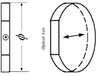
from Ross Optical Industries
The low (multiple) order waveplate is designed to give a retardance of several full waves, plus the desired fraction. This results in a single, physically robust component with desired performance. However, even small changes in wavelength or temperature will result in significant changes in the... [See More]
- Surface Flatness: λ/2
- Polarizer Application: Infrared; Visible; Ultraviolet
- Optical Polarizer: Waveplate / Retardation Plate
- Wavelength Range: 266 to 1550
from Tower Optical Corporation
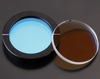
Tower Optical offers this second series of Achromatic Waveplates (AWP ’s) which are built using 25.4 mm substrates of crystal quartz and magnesium fluoride. These substrates are cemented together. This technique helps to control costs by reducing the number of surfaces requiring AR coating... [See More]
- Surface Flatness: λ/2; λ/4
- Wavelength Range: 465 to 1650
- Optical Polarizer: Waveplate / Retardation Plate
- Clear Aperture: 23
from Daheng New Epoch Technology, Inc.
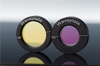
Crystalline quartz is frequently used for the high quality retardation applications. Air Space Quartz Zero-Order Wave plates consist of two precision polished quartz plates. The fast axes of two plates are orthogonal to each other. The wave plates are insensitive to wavelength, temperature and angle... [See More]
- Surface Flatness: λ/2; λ/4
- Wavelength Range: 355 to 1064
- Optical Polarizer: Waveplate / Retardation Plate
from EKSMA OPTICS
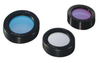
Zero order wave plates are used to rotate the direction of polarization (with λ/2 plates) or convert linear into circular polarization or vice versa (with λ/4 plates). Zero order wave plates are made from two thin sections which are polished to different thicknesses to have retardation... [See More]
- Surface Flatness: λ/2; λ/4
- Wavelength Range: 257 to 1550
- Optical Polarizer: Waveplate / Retardation Plate
- Clear Aperture: 17
from Ross Optical Industries
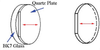
Made of a single quartz plate that is very thin, true zero order waveplates are provided either by themselves as a single plate for high damage threshold applications (greater than 1 GW/cm2), or as a cemented plate on a BK7 substrate to provide strength. [See More]
- Surface Flatness: λ/2
- Polarizer Application: Infrared; Visible
- Optical Polarizer: Waveplate / Retardation Plate
- Wavelength Range: 532 to 1550
from Ross Optical Industries
The zero order waveplate is designed to give a retardance of zero full waves, plus the desired fraction. Zero Order Waveplates show better performance than multiple order waveplates. They show a broader bandwidth and a lower sensitivity to temperature and wavelength changes and should be considered... [See More]
- Surface Flatness: λ/2
- Polarizer Application: Infrared; Visible; Ultraviolet
- Optical Polarizer: Waveplate / Retardation Plate
- Wavelength Range: 266 to 1550