
λ/10 Cylindrical Lenses
Last Updated: April 1, 2025
Description
?/10 Cylindrical Lenses are optical components designed to focus or expand light into a line rather than a point. These lenses have a unique cylindrical shape that allows them to manipulate light in one dimension, making them essential for applications requiring precise control over light direction and focus.
Working Principle
Cylindrical lenses work by bending and focusing light along a single axis. This is achieved through their cylindrical shape, which allows them to compress or expand light in one dimension. The ?/10 specification refers to the surface accuracy of the lens, indicating that the surface irregularities are less than one-tenth of the wavelength of light used, ensuring high precision and minimal distortion. This precision makes them particularly useful in applications where exact light manipulation is critical.
Applications
Cylindrical lenses are used in a variety of specialized applications. They are commonly employed in generating a line of light from a collimated laser, which is useful in laser scanning and bar code reading. They are also used in optical information processing, spectroscopy, and holographic lighting. In imaging systems, they help correct astigmatism and adjust image height, and they are instrumental in creating circular laser beams from elliptic ones.
Advantages over other Cylindrical Lenses
The ?/10 cylindrical lenses offer superior surface accuracy compared to standard cylindrical lenses, which typically have a surface figure of ?/4. This higher precision results in better performance in applications requiring minimal optical distortion and high-quality light manipulation. The enhanced surface quality ensures that these lenses can deliver more accurate and reliable results in demanding optical systems.
Limitations
One limitation of ?/10 cylindrical lenses is the increased complexity and cost associated with their production. Achieving the high surface accuracy of ?/10 requires more precise manufacturing processes, which can lead to higher initial costs compared to lenses with lower precision specifications.
Considerations
When considering ?/10 cylindrical lenses, it is important to account for the initial cost, which may be higher due to the precision manufacturing required. However, the investment can be justified by the increased accuracy and performance in critical applications. Operating expenses are generally low, but maintenance and replacement costs should be considered, especially in environments where lenses are exposed to harsh conditions. Durability is typically high, but regular inspections are recommended to ensure continued performance and to address any potential surface damage that could affect accuracy.

from CeNing Optics Co., Ltd.
Custom Capabilities of Spherical and Cylindrical Lenses. Diameter: From 0.5mm to 300mm. Diameter Tolerance: +/-0.01mm. Thickness Tolerance: +/-0.01mm. Irregularity: 0.2, (PV: Lambda/20). Centration: 30 arc sec. Surface Quality: 10-5 S/D. Quality Facility Machinery: Polishing Machines. Grinding... [See More]
- Surface Flatness: λ/10
- Lens Application: Infrared (optional feature); Visible
- Lens Form: Plano-Convex (optional feature); Plano-Concave (optional feature)
- Focal Length: 2 to 5000

from Fairfield Crystal Technology, LLC.
OPTICAL COMPONENT MANUFACTURING. Fairfield Crystal provides component manufacturing for your most challenging designs and applications. Combined with our expertise in crystal growth our component fabrication team is able to manufacture highly polished single crystal lenses, prisms, wedges,... [See More]
- Surface Flatness: λ/2; λ/4; λ/5; λ/8; λ/10; λ/20
- Materials: Calcium Fluoride; Zinc Selenide
- Lens Application: Infrared; Visible; Ultraviolet
- Surface Quality: 10-5 Scratch / Dig; 20-10 Scratch / Dig; 40-20 Scratch / Dig; 60-40 Scratch / Dig; 80-50 Scratch / Dig
from Changchun Sunday Optics Co., Ltd.
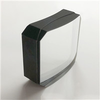
Schmidt prisms are used to invert and revert an image to angle of 45 °. The 45 ° deviation makes Schmidt prisms useful in eyepiece assemblies and imaging systems requiring a path bend. The aluminized roof surfaces enhance the overall efficiency while the high accuracy roof angle tolerance... [See More]
- Surface Flatness: λ/10
- Surface Quality: 10-5 Scratch / Dig
- Materials: Germanium; Sapphire; Optical glass, UVFS, Germanium, Silicon, CaF2, MgF2, ZnSe ZnS, Sapphire
- Lens Features: Antireflection Coating

from ECOPTIK (CHANGCHUN) LTD
A cylindrical lens is typically used to focus, condense or expand incoming light. A cylindrical lens has one cylindrical surface, causing light to be focused in a single dimension or axis. It can also be used to expand the output of a laser diode into a symmetrical beam. Cylindrical lenses are... [See More]
- Surface Flatness: λ/2; λ/4; λ/5; λ/8; λ/10
- Length: 2 to 200
- Lens Application: Visible
- Materials: Sapphire; Optical Glass, Fused Silica
from Changchun Sunday Optics Co., Ltd.
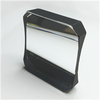
Sunday Optics provides many kinds of roof prisms including Schmidt Roof Prism 、Lehmann Roof Prism 、Abbe Roof Prism 、Penta Roof Prism and Combined Roof Prism, etc. [See More]
- Surface Flatness: λ/10
- Surface Quality: 10-5 Scratch / Dig
- Materials: Germanium; Sapphire; Optical glass, UVFS, Germanium, Silicon, CaF2, MgF2, ZnSe ZnS, Sapphire
- Lens Features: Antireflection Coating

from ECOPTIK (CHANGCHUN) LTD
Meniscus Cylindrical Lens can increase the NA of the system while only adding slightly to the total spherical aberrations. The Negative Meniscus Lens is used to increase the focal length of another lens while maintaining the angular resolution of the optical assembly. This lens shape is best used... [See More]
- Surface Flatness: λ/2; λ/4; λ/5; λ/8; λ/10
- Center Thickness: 2 to 20
- Lens Application: Visible
- Materials: Sapphire; Optical Glass, Fused Silica
from Changchun Sunday Optics Co., Ltd.
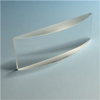
Sunday Optics manufacture Right Triangular Angle Prism according to customer size and drawing. [See More]
- Surface Flatness: λ/10
- Surface Quality: 10-5 Scratch / Dig
- Materials: Germanium; Sapphire; Optical glass, UVFS, Germanium, Silicon, CaF2, MgF2, ZnSe ZnS, Sapphire
- Lens Features: Antireflection Coating

from ECOPTIK (CHANGCHUN) LTD
A plano-concave cylindrical lens is used to expand light in on axis. A negative cylindrical lens is able to diverge collimated input light away from a line. Plano-concave cylindrical lenses are used for one-dimensional compression of images, anamorphic beam shaping, and laser line generation. The... [See More]
- Surface Flatness: λ/2; λ/4; λ/5; λ/8; λ/10
- Lens Application: Visible
- Lens Form: Plano-Concave
- Center Thickness: 2 to 20