
Noncontact Torque Limiters and Slip Clutches
Description
Noncontact torque limiters and slip clutches are devices designed to protect mechanical systems from damage due to torque overloads. They achieve this by disengaging the drive when the torque exceeds a predetermined threshold, thereby preventing the transmission of excessive force that could harm the system.
Working Principle
Noncontact torque limiters and slip clutches operate using magnetic fields and eddy currents to transmit power without physical contact between components. This noncontact method allows for smooth disengagement when the torque exceeds the set limit, ensuring that the drive system is protected from overloads. These devices are particularly useful because they can automatically reset and resume normal operation once the overload condition is resolved, minimizing downtime and maintenance requirements.
Applications
Noncontact torque limiters and slip clutches are used in various applications where precise torque control is critical. For example, they are employed in conveyor systems to prevent mechanical jams and in sensitive equipment where maintaining operational integrity is crucial. They are also used in applications requiring frequent engagement and disengagement without wear, such as in automated machinery and robotics.
Advantages over other Torque Limiters and Slip Clutches
One significant advantage of noncontact torque limiters over traditional shear pin technology is their maintenance efficiency and disengagement accuracy. According to , torque limiters can disengage at a precision of +/-5%, compared to the +/-20% accuracy of shear pins. This precision is vital for protecting sensitive equipment. Additionally, noncontact designs reduce wear and tear since there is no physical contact during operation, leading to longer service life and reduced maintenance costs.
Limitations
A limitation of noncontact torque limiters is their initial cost, which can be higher than traditional mechanical systems. Additionally, they may not be suitable for all applications, particularly those requiring high torque transmission without slippage, as noncontact systems rely on magnetic fields which may not provide the same level of torque as mechanical engagements.
Considerations
When considering noncontact torque limiters and slip clutches, it is essential to evaluate the initial costs and operating expenses. While the upfront investment may be higher, the reduced maintenance and downtime can offset these costs over time. Durability is another factor, as noncontact systems typically experience less wear and tear, leading to longer lifespans. Accuracy in disengagement is a critical advantage, ensuring protection for sensitive equipment. Replacement and maintenance costs are generally lower due to the reduced need for physical contact and wear-related repairs.

from Ringfeder Power Transmission USA Corporation
GERWAH's couplings from the 'MKS' series are a special modification of the permanent magnetic synchronous coupling MKD with an extended air slot. Especially in pumps, the system displays all its advantages. It allows torque transmission into a hermetically sealed container, for example, so that the... [See More]
- Engagement: NonContact
- Torque: 8.8 to 132.7
- Device: Slip clutch / Disengagement Torque Limiter
- Shaft: In-line

from Ringfeder Power Transmission USA Corporation
GERWAH's permanent magnetic hysteresis coupling from the 'HKD' series consists of two separate unsupported halves. The coupling is connected with the shaft by means of clamping hubs. Thanks to its pioneering concept, HKD transmits torque smoothly in a 'sliding' manner which is completely wear-free. [See More]
- Engagement: NonContact
- Torque: 0.1 to 3.7
- Device: Slip clutch / Disengagement Torque Limiter
- Shaft: In-line
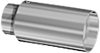
from Ringfeder Power Transmission USA Corporation
A slim design and flexible mounting possibilities: the magnetic hysteresis couplings from the 'HLV' series can be used for many purposes. Their rated torque level can be adapted individually thanks to a user-friendly scale. On request, HLV is available in stainless steel, too. Especially in the... [See More]
- Engagement: NonContact
- Torque: 0.3 to 2.9
- Device: Slip clutch / Disengagement Torque Limiter
- Shaft: In-line

from Ringfeder Power Transmission USA Corporation
The compact design and the flexible mounting possibilities of GERWAH's magnetic hysteresis coupling 'HSV' open up a wide field of possible applications. Its innovative concept qualifies this element for use in bottle capping machines as well as in roll-up and unroll systems, and in test engineering. [See More]
- Engagement: NonContact
- Torque: 0.3 to 2.9
- Device: Slip clutch / Disengagement Torque Limiter
- Shaft: Parallel

from Ringfeder Power Transmission USA Corporation
The permanent magnetic synchronous coupling 'MKD' consists of two separate halves which have to be supported by the customer and are then telescoped. The special feature of MKD: the maximum transmittable torque can be changed by modifying the hub submergence. At overload status, the coupling will... [See More]
- Engagement: NonContact
- Torque: 0.9 to 110.6
- Device: Slip clutch / Disengagement Torque Limiter
- Shaft: In-line