
Freewheeling Clutch Torque Limiters and Slip Clutches
Description
Freewheeling clutch torque limiters and slip clutches are mechanical devices designed to manage torque transmission in machinery. They serve to protect equipment by disengaging or slipping when the torque exceeds a predetermined threshold, preventing damage to the drivetrain components.
Working Principle
Freewheeling clutches are unidirectional torque transmitters that allow the drive element to spin freely in the opposite direction of the intended drive rotation. This mechanism is particularly useful in preventing reverse motion in systems like inclined conveyors. Slip clutches or disengagement torque limiters operate by disengaging the drive when a torque overload occurs. They utilize friction between contact surfaces to transmit power, and when the torque exceeds the set limit, they slip to prevent damage. This slipping action is crucial for protecting both personnel and equipment from potential harm due to mechanical jams or overloads.
Applications
Freewheeling clutches are commonly used in applications where reverse motion needs to be prevented, such as in backstop mechanisms for inclined conveyors. Slip clutches are widely used in machinery where safety and equipment protection are paramount, such as in conveyor systems, packaging machines, and other automated equipment that may experience jamming or overload conditions.
Advantages over other Torque Limiters and Slip Clutches
Sprag clutches, a type of slip clutch, can often transmit more torque than other designs of slip or overrunning clutches. This makes them advantageous in applications requiring higher torque transmission without the risk of slipping under normal operating conditions.
Limitations
Freewheeling clutches require manual re-engagement after disengagement, which can lead to downtime in operations. Additionally, toothed clutches, which are a type of slip clutch, can only be engaged at slow speeds, limiting their use in high-speed applications.
Considerations
When selecting freewheeling clutch torque limiters and slip clutches, it is important to consider factors such as initial costs, operating expenses, and maintenance requirements. Freewheeling clutches, for instance, may incur higher maintenance costs due to the need for manual re-engagement. The durability and accuracy of these devices are also critical, as they must reliably disengage or slip at the specified torque limits to effectively protect machinery. Replacement and maintenance costs should be factored into the overall cost of ownership, as these can vary depending on the specific type and application of the clutch.
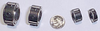
from Tiny-Clutch | Helander Products, Inc.
CR-Series Tiny-Clutches are captured roller and cam assemblies that work the same as our D-Series, but which are installed in your housing. The clutch has near zero backlash & allows high overrunning speeds, making them ideal for machines requiring overrunning, backstopping, freewheeling or... [See More]
- Device: Overrunning; Freewheeling; Backstop
- Rotary Speed: 7000
- Torque: 0.3
- Engagement: Roller Detent
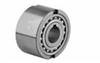
from Renold Canada
The Renold REGF Series Trapped Roller Freewheels are self-centering: sizes 8 to 20 use plain bearings and sizes 25 to 130 use a pair of 160 series ball bearings. This allows improved speed capacity for the larger freewheels. Torque is transmitted to the inner race via a key and the outer race by... [See More]
- Device: Freewheeling
- Mounting: Shaft
- Shaft: In-line
- Diameter: 1.46 to 11.81
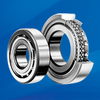
from GMN Paul Muller Industrie GmbH & Co. KG
GMN freewheels are unidirectional couplings, transmitting or supporting torque in one direction by friction and allowing idling in the opposite direction. Freewheel clutches can be used as indexing devices, backstops or overrunning clutches. Our sprag type freewheel clutch guarantees highest torque... [See More]
- Device: Freewheeling
- Bore Diameter: 0.3937 to 2.36
- Attachment: Keyway
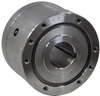
from Hilliard Corporation (The)
Hilliard Sprag Clutches are designed for overrunning, backstopping and indexing applications. This clutch is a freewheeling device with an inner race and an outer race, either of which can be the input or output member. The input can drive the output in a chosen direction and permit the output to... [See More]
- Device: Overrunning; Freewheeling; Backstop
- Rotary Speed: 375 to 3600
- Torque: 275.0 to 36600.0
- Engagement: Roller Detent; Sprag
from GMN Bearing, USA Ltd.
Free-wheel clutch, roller ramp technology [See More]
- Device: Freewheeling
- Engagement: Roller Ramp
- Torque: 11.0
- Shaft: In-line

from Renold Canada
Renold REGL Series Trapped Roller Freewheels are self-centering by means of a pair of 160 series ball bearings. Torque is transmitted to the inner race via a key and the outer race by means of bolts. Components mounted onto the outside diameter of the outer race should be bored to an H7 tolerance. [See More]
- Device: Freewheeling
- Mounting: Shaft
- Shaft: In-line
- Diameter: 2.44 to 15.75
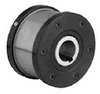
from Renold Canada
The REGLP F7-D7 series comprises an REGL base unit freewheel, combined with an F7 Fixing Flange and a D7 Cover Flange. Torque is transmitted to the inner race via a key from the shaft and the outer race by means of an external key. Shaft tolerance must be h6/j6. The unit is supplied with two paper... [See More]
- Device: Freewheeling
- Mounting: Shaft
- Shaft: In-line
- Diameter: 2.44 to 15.75
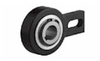
from Renold Canada
The Renold REGV Series Trapped Roller Freewheels are self-centering by means of plain bearings. Torque is transmitted to the inner race via a key and the outer race via the torque arm. Shaft tolerance must be h6. The primary use for the REGV freewheels is as a backstop. The freewheel should be fixed... [See More]
- Device: Freewheeling
- Mounting: Shaft
- Shaft: In-line
- Diameter: 3.27 to 11.81
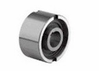
from Renold Canada
Renold REUF Series Trapped Roller Freewheels are non self-centering. Bearings must be placed adjacent to the freewheel to ensure concentricity between inner and outer races. Torque is transmitted to the inner race via a key and the outer race by means of either face keys or interference fit. If the... [See More]
- Device: Freewheeling
- Mounting: Shaft
- Shaft: In-line
- Diameter: 1.46 to 12.60
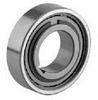
from Renold Canada
Renold REUS Series Trapped Roller Freewheels are non self-centering. Bearings must be placed adjacent to the freewheel to ensure concentricity between inner and outer races. The REUS Series freewheels have the same outside dimensions as standard 62 series bearings. Torque is transmitted to the inner... [See More]
- Device: Freewheeling
- Mounting: Shaft
- Shaft: In-line
- Diameter: 0.94 to 4.33
from Renold Canada
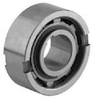
Renold REUSNU Series Trapped Roller Freewheels are non self-centering. Bearings must be placed adjacent to the freewheel to ensure concentricity between inner and outer races. The REUSNU Series freewheels have the same outside dimensions as standard 63 series bearings. Torque is transmitted to the... [See More]
- Device: Freewheeling
- Mounting: Shaft
- Shaft: In-line
- Diameter: 1.38 to 6.69