
Polarizing Microscopes
Description
Polarizing microscopes are specialized optical instruments designed to enhance the contrast of specimens that exhibit birefringence. They achieve this by utilizing polarized light to highlight specific structural features within the sample, allowing for detailed visualization of materials that would otherwise appear uniform under standard lighting conditions.
Working Principle
Polarizing microscopes operate by using two polarizers that are perpendicular to each other. The first polarizer, known as the polarizer, polarizes the light in one plane before it reaches the specimen. As the light passes through the specimen, regularly spaced, patterned, or crystalline portions of the sample rotate the light. The second polarizer, known as the analyzer, only allows light that has been rotated by the specimen to pass through, resulting in bright areas against a dark background. This technique is particularly useful for examining materials with anisotropic properties, as it can reveal variations in refractive index and structural orientation within the sample .
Applications
Polarizing microscopes are widely used in fields that require the analysis of birefringent materials. Specific examples include:
- Biological Research: Used to study filamentous proteins and fibers in biological specimens, which exhibit birefringence due to their anisotropic molecular order .
- Geology: Essential for identifying minerals and rocks, as many geological specimens have crystalline structures that can be analyzed using polarized light.
- Material Science: Employed to examine polymers and liquid crystals, providing insights into their structural properties and behaviors.
Advantages over other Microscopes
Polarizing microscopes offer distinct advantages when analyzing birefringent materials. Unlike standard microscopes, they can reveal structural details that are not visible under normal lighting conditions. This capability makes them invaluable for studying materials with specific optical properties, such as birefringence, which cannot be effectively analyzed using other types of microscopes.
Limitations
One limitation of polarizing microscopes is their specificity to birefringent materials. They are not suitable for examining isotropic materials, which do not alter the polarization state of light. Additionally, the requirement for precise alignment of polarizers and analyzers can make these microscopes more complex to operate compared to standard optical microscopes.
Considerations
When considering the acquisition and use of a polarizing microscope, several factors should be taken into account:
- Initial Costs: Polarizing microscopes can be more expensive than standard microscopes due to their specialized components.
- Operating Expense: The need for precise alignment and calibration may require additional training and maintenance, potentially increasing operational costs.
- Durability and Maintenance: Regular maintenance is essential to ensure the accuracy and longevity of the microscope, particularly in environments where it is frequently used.
- Accuracy: The precision of polarizing microscopes in analyzing birefringent materials is unmatched, but this accuracy depends on proper calibration and alignment of the optical components.

from Evident Scientific
Better Images and Results. DSX1000 digital microscopes enable faster failure analysis with guaranteed accuracy and repeatability. Large selection of lenses that are easy to change. Switch between 6 different observation methods by pushing a button. Fast macro to micro viewing. Accurate measurements... [See More]
- Microscope Type: Polarizing; Telecentric Optical System
- Grade: Benchtop
- Application: Measuring / Toolmaker / Inspection; Metallurgical; Semiconductor; Wiring Boards, Fractured Infrastructure Metal, Automotive Part Inspection Applications
- Optical Technique: Brightfield, Darkfield, MIX [BF + DF], Differential Interference Contrast, Polarized Light
from Nikon Metrology
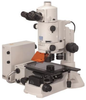
A multi-purpose zoom microscope system that provides capabilities that don't currently exist with stereomicroscopes and compound high magnification microscopes. The AZ100 Multizoom represents a new concept in zoom microscopes. It covers an extremely wide range of magnifications, from 5x to 400x,... [See More]
- Microscope Type: Polarizing; Stereomicroscope
- Grade: Benchtop
- Application: Gemological; Metallurgical; Semiconductor; Electronics, Composites
- Optical Technique: Transmitted Light: Brightfield, Nomarski Dic, Simple Polarizing, And Oblique Illumination Observation
from Unitron Ltd.
45 ° incline head, ball bearing stage, rack and pinion substage [See More]
- Microscope Type: Compound; Polarizing
- Grade: Benchtop
- Application: Biological / Life Sciences
- Optical Technique: Polarizing

from Nikon Metrology
The MA100N is a compact inverted microscope designated for bright field and simple polarizing observations. Responding to the requests from manufacturing and QA/QC sections in a variety of industries, Nikon developed this simple but durable model which enables high contrast image observation... [See More]
- Microscope Type: Polarizing; Stereomicroscope
- Grade: Benchtop
- Application: Metallurgical; Semiconductor; Electronics, Composites
- Optical Technique: Bright?eld and Polarization (with MA P/A Simple Polarizer/Analyzer Set)

from Nikon Metrology
Slim and compact, the ECLIPSE Ci-POL is a personal-type polarizing microscope that doesn't occupy your entire desk. With cutting-edge CFI60 infinity optics, it offers advanced optical performance and user-friendly operation. Built-in capture button located near the front of the microscope base... [See More]
- Microscope Type: Polarizing
- Grade: Benchtop
- Application: Electronics, Composites
- Magnification: 40 to 1000