
Intel® Celeron® Network Servers
Description
Intel® Celeron® Network Servers are designed to provide essential server capabilities with a focus on cost-effectiveness and energy efficiency. These servers are equipped with Intel Celeron processors, which are known for their low power consumption and adequate performance for basic server tasks. They are suitable for environments where high processing power is not a critical requirement, offering a balance between performance and cost.
Working Principle
Intel® Celeron® Network Servers operate by utilizing the Celeron processor's architecture, which is optimized for low power usage and heat generation. This makes them ideal for tasks that do not require intensive computational power. The servers manage data and network traffic efficiently, ensuring that basic server operations are handled smoothly. The low power consumption of Celeron processors contributes to reduced operational costs and less heat output, which can be beneficial in maintaining server longevity and reliability.
Applications
Intel® Celeron® Network Servers are typically used in scenarios where high processing power is not necessary. Specific examples include:
- Small business environments where the server is used for file storage and basic network management.
- Educational institutions that require servers for hosting simple applications and managing network resources.
- Home offices or small-scale setups where the server is used for personal data storage and media streaming.
Advantages over other Network Servers
One of the primary advantages of Intel® Celeron® Network Servers is their cost-effectiveness. They provide a budget-friendly option for organizations that do not require high-performance servers. Additionally, their low power consumption translates to lower energy costs, making them an economical choice for long-term use. The reduced heat generation also means that cooling requirements are less demanding, which can further decrease operational expenses.
Limitations
Intel® Celeron® Network Servers have limitations in terms of processing power and scalability. They are not suitable for environments that require high-performance computing or handle large volumes of data processing. The lower processing capabilities can lead to slower performance when running multiple applications or handling complex tasks, which may not meet the needs of larger enterprises or data-intensive applications.
Considerations
When considering Intel® Celeron® Network Servers, it is important to evaluate the initial costs, which are generally lower compared to high-performance servers. Operating expenses are also reduced due to the energy-efficient nature of Celeron processors. However, potential buyers should assess whether the server's performance aligns with their specific needs, as the lower processing power may not be suitable for all applications. Durability and maintenance costs are typically manageable, but users should be aware of the limitations in scalability and performance when planning for future growth or increased demand.
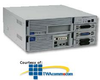
from TelephoneStuff.com
The chassis comes fully equipped with a Intel Celeron 1.2Ghz, 256 MB of SDRAM, a 20G EIDE, and Auto-Sensing 300 Watts Power Supply (90/264 VAC, 6.0 A/3.0 A, 60/50 Hz). (H) 7.1" [18cm] x (W) 17.5" [44.5cm] x (D) 18.3" [46.5cm]. The BCM 400 has several powerful software applications preinstalled. Some... [See More]
- Processor Type: Intel Celeron
- Server Type: Network Server

from Lenovo
4U/5U tower server that delivers business-class performance, energy efficiency, & reliability in a compact tower. [See More]
- Processor Type: Intel Pentium III Xeon; Intel Celeron
- Main Memory: 32000
- Form Factor: Desktop / Pedestal
- Cache Memory: 8000

from Lenovo
This 1P server fits many enterprise features into a compact 1U package, including fast processors, plenty of TruDDR4 memory and storage, enterprise management, and HA features. [See More]
- Processor Type: Intel Pentium III Xeon; Intel Celeron
- Processor Speed: 2400
- Form Factor: Rack Mounted
- Processors Supported: 1