
Eccentricity / Concentricity Form Gages and Form Gaging Systems
Description
Eccentricity and concentricity form gages and form gaging systems are precision instruments used to measure geometric forms. These systems are specifically designed to assess parameters such as eccentricity and concentricity, which are critical in ensuring that components meet stringent design specifications. They provide detailed measurements that help in evaluating the geometric accuracy of parts, ensuring that they conform to required standards.
Working Principle
Eccentricity and concentricity form gages operate by measuring the deviation of a part's surface from a perfect geometric form. These systems can be either contact-based, where a stylus is dragged across the surface to record height variations, or non-contact, using optical methods such as laser scanning to capture surface profiles. The data collected is used to calculate the eccentricity and concentricity of the part, which are essential for determining the uniformity and alignment of components. These measurements are crucial for maintaining the integrity and functionality of mechanical systems, as they ensure that parts fit together correctly and operate smoothly.
Applications
Eccentricity and concentricity form gages are widely used in industries where precision is paramount. For example, in the automotive industry, these gages are used to ensure that engine components such as pistons and bearings are perfectly aligned to prevent wear and tear. In the aerospace sector, they are critical for verifying the concentricity of turbine blades and other components to ensure optimal performance and safety. Additionally, in the manufacturing of medical devices, these gages help in maintaining the precision required for components that must meet strict regulatory standards.
Advantages over other Form Gages and Form Gaging Systems
One of the primary advantages of eccentricity and concentricity form gages is their ability to provide highly accurate and detailed measurements of geometric forms. Unlike other gaging systems that may only offer basic dimensional checks, these gages can detect minute deviations from the ideal form, which is crucial for high-precision applications. Their ability to measure both 2D and 3D profiles allows for a comprehensive analysis of a part's geometry, making them superior in applications where precision is non-negotiable.
Limitations
Despite their advantages, eccentricity and concentricity form gages have limitations. They can be complex to operate, requiring skilled personnel to interpret the data accurately. Additionally, the initial cost of these systems can be high, which may be prohibitive for smaller operations. The precision of these gages also means they are sensitive to environmental conditions, such as temperature and vibration, which can affect measurement accuracy.
Considerations
When investing in eccentricity and concentricity form gages, several factors should be considered. The initial cost can be significant, but this is often offset by the long-term benefits of improved product quality and reduced waste. Operating expenses include maintenance and calibration, which are necessary to ensure continued accuracy. Durability is another consideration; while these systems are built to last, they require regular maintenance to prevent wear and tear. Accuracy is paramount, and regular calibration is essential to maintain it. Replacement and maintenance costs should also be factored into the total cost of ownership, as these can vary depending on the complexity of the system and the frequency of use.

from Mahr Inc.
Product features. Reference form measuring machine for the precision measuring room and production with tactile and optical probe. Use of the benefits of the most modern, optical metrology. Non-tacticle measurement of sensitive parts. Particularly high measuring accuracy. Lowers your production... [See More]
- Form Parameters: Coaxiality; Cylindricity or Cylinder Gage; Differential / Taper; Eccentricity / Concentricity; Flatness; Parallelism; Roundness; Runout; Straightness
- Technology: Optical / Laser
- Scan Rate: 3.94E-4 to 1.97
- Mounting / Loading Options: Floor

from Carl Zeiss Industrial Metrology, LLC
Compact form tester with precision rotary table on air bearings and analysis functions from the high class machines, such as Fourier analysis. Precise rotary table on air bearings for top radial runout properties and excellent measurement of narrow tolerances. Patented software support with graphic... [See More]
- Form Parameters: Cylindricity or Cylinder Gage; Eccentricity / Concentricity; Roundness; Straightness
- Load / Weight: 25
- Additional Capability: 2D / Line Profile; Area or three dimensional profile
- Technology: Contact / Stylus

from Carl Zeiss Industrial Metrology, LLC
Form tester for large workpieces. RONDCOM 55. Universal form tester with optional roughness measurement for large and exact workpieces. Highly accurate, wear-free rotary table on air bearings; accuracy of 20 nanometers. Higher throughput through fast, automatic alignment. Large deflection range and... [See More]
- Form Parameters: Cylindricity or Cylinder Gage; Eccentricity / Concentricity; Roundness; Straightness
- Load / Weight: 60
- Additional Capability: 2D / Line Profile; Area or three dimensional profile
- Technology: Contact / Stylus

from Carl Zeiss Industrial Metrology, LLC
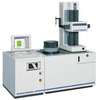
Highly accurate form tester from the reference class for excellent measurement of the tightest tolerances. Ultra-accurate, wear-free rotary table on air bearings. Accuracy 20 nanometers with load capacity of 60 or 100 kg. Extreme long-term stability through design quality and heavy granite axes. [See More]
- Form Parameters: Cylindricity or Cylinder Gage; Eccentricity / Concentricity; Roundness; Straightness
- Load / Weight: 60
- Additional Capability: 2D / Line Profile; Area or three dimensional profile
- Technology: Contact / Stylus
from Carl Zeiss Industrial Metrology, LLC
Form tester in the ultra class. Ultra-accurate, wear-free rotary table on air bearings; accuracy of 10 nanometers. Extreme long-term stability through design quality and heavy granite axes. Ultra precision through R, Z and rotary axes on air bearings. Thermally insulated, active vibration-insulated... [See More]
- Form Parameters: Cylindricity or Cylinder Gage; Eccentricity / Concentricity; Roundness; Straightness
- Technology: Contact / Stylus
- Additional Capability: 2D / Line Profile; Area or three dimensional profile
- Applications: Automotive

from Carl Zeiss Industrial Metrology, LLC
RONDCOM 54. Highly accurate form tester with the highest accuracy in its class and a wide range of applications. Highly accurate, wear-free rotary table on air bearings. Accuracy: 20 nanometers. Higher throughput through fast, automatic alignment. Large deflection range and high resolution of the... [See More]
- Form Parameters: Cylindricity or Cylinder Gage; Eccentricity / Concentricity; Roundness; Straightness
- Technology: Contact / Stylus
- Additional Capability: 2D / Line Profile; Area or three dimensional profile
- Applications: Automotive