
Products & Services
See also: Categories | Featured Products | Technical Articles | More Information-
Supplier: Accuris
Description: Non-destructive testing \x97 Characterization and verification of ultrasonic test equipment Part 3: Combined equipment
-
Supplier: Accuris
Description: Non-destructive testing \x96 Characterization and verification of ultrasonic test equipment \x96 Part 3: Combined equipment
-
Supplier: Accuris
Description: Non-destructive testing - Ultrasonic testing - Characterization and verification of ultrasonic thickness measuring equipment
-
-
Supplier: Accuris
Description: Non-destructive testing \x97 Characterization and verification of ultrasonic test equipment Part 1: Instruments
-
Description: beam produced by this apparatus. Relates only, for the time being, to ultrasonic therapeutic equipment employing plane circular transducers.
-
Supplier: CSA Group
Description: for verifying equipment covered by EN 12668 when used for thickness measurement.
-
Description: for verifying equipment covered by EN 12668 when used for thickness measurement.
-
Supplier: M.A.E. Apparecchiature Elettroniche srl
Description: usually a foundation pole. An ultrasonic wave is sent from a transmitting to a receiver device, which are automatically guided from the instrument along total length of the pole entirely “drowned” during casting. Velocity of the sonic wave and its energy are strongly influenced by the quality
- Features: Material Condition, Microstructure, Programmable / Digital Control Unit, Ultrasonic
- Form Factor: Monitoring System
-
Supplier: M.A.E. Apparecchiature Elettroniche srl
Description: SONIC15 is a device for non Destructive Tests with ultrasonic pulse velocity and sonic tests on masonry through instrumented hammer. It also supports expansion for surveys on foundation piles with P.I.T. methodology. In spite of compact dimension of the unit, there is a wide monitor of 7’’
- Features: Material Condition, Microstructure, Programmable / Digital Control Unit, Ultrasonic
- Form Factor: Portable / Hand Held / Mobile
-
Supplier: IRISS, Inc.
Description: The versatility of Sonus XT makes it ideally suited to work with any plant maintenance program and the perfect complement to other Predictive Maintenance (PDM) Technology. Ultrasound detection can be utilized to detect early warning signs of equipment failure and to conduct energy
- Instrument Type: Condition Monitor / Fault Detector
- Features: Electrical Faults / Condition, Ultrasonic
- Form Factor: Portable / Hand Held / Mobile
-
Description: ASNT’s Personnel Training Publications: the Ultrasonic Testing (UT) Instructor Package. Designed exclusively for teaching, the instruction kit provides a complete set of training materials that focuses on the fundamentals for Levels I and II. The multimedia Instructor Package includes:
-
Supplier: IRISS, Inc.
Description: tracking, arcing or corona. PD detection can be utilized to detect early warning signs of equipment insulation failure. Inspections can be performed quickly and safely by maintenance personnel with minimal training. Fast and accurate diagnosis of problems using the SONUS PD will help you
- Instrument Type: Condition Monitor / Fault Detector
- Features: Electrical Faults / Condition, Ultrasonic
- Form Factor: Portable / Hand Held / Mobile
-
Supplier: CSA Group
Description: ISO 18563-1:2015 identifies the functional characteristics of a multichannel ultrasonic phased array instrument used for phased array probes and provides methods for their measurement and verification. ISO 18563-1:2015 can partly be applicable to ultrasonic phased array instruments in
-
Supplier: CSA Group
Description: ISO 18563-2:2017 specifies the characterization tests performed at the end of the fabrication of a phased array probe. It defines both methodology and acceptance criteria. ISO 18563-2:2017 is applicable to the following phased array probes used for ultrasonic non-destructive testing in
-
Supplier: CSA Group
Description: ISO 19675:2017 specifies requirements for the dimensions, material and manufacture of a steel block for calibrating ultrasonic test equipment used in ultrasonic testing with the phased array technique.
-
Supplier: RS Components, Ltd.
Description: Ultrasonic leak detector
- Operating Temperature: 122 F
- Display Type: Digital Readouts
- Leak Test Method: Ultrasonic Leak Detector
-
Description: ISO 17640:2010 specifies techniques for the manual ultrasonic testing of fusion-welded joints in metallic materials of thickness greater than or equal to 8 mm which exhibit low ultrasonic attenuation (especially that due to scatter) at object temperatures from 0 °C to 60 °C. It
-
Supplier: Benchmark Maintenance Services, Inc.
Description: instruments. By detecting the ultrasonic sound created by turbulence and friction in industrial equipment, these extraordinary instruments pinpoint compressed air leaks, vacuum leaks, refrigerant leaks, worn bearings, and internal leaks through valves and steam traps. Several models
- Features: Ultrasonic
-
Supplier: DigiKey
Description: UC12-12231 ULTRASONIC SENSOR
- Features: Ultrasonic
-
Supplier: Nex Flow Air Products Corp.
Description: The Flex.US Ultrasonic Leak Detector is a hand held, high quality compressed air leak detection system that has all the features necessary for flexible use in finding costly air leaks. The FLEX.US ultrasonic leak detector kit comes with the FLEX.US unit, carrying case, and manual and
- Leak Test Method: Ultrasonic Leak Detector
-
Supplier: Cleaning Technologies Group
Description: ultrasonic transducers are powered by Blackstone-NEY proprietary ultrasonic generators. In installations of large numbers of transducers, Blackstone-NEY Ultrasonics generators can each provide up to 2,000 watts of ultrasonic power each reducing the number of generators
- Transducer Style: Immersible / Waterproof
- Application: Ultrasonic Cleaning / Liquid Processing
-
Description: Contains new chapters on phased array, time of flight diffraction, and guided wave method. Follows the body of knowledge outlined in CP-105 (2011). Up-to-date information on ultrasonic principles, equipment, specialized techniques, and test applications. Also covers qualification and
-
Description: This Particular Standard specifies requirements and tests for the safety of ultrasonic physiotherapy equipment. It amends and supplements IEC 60601-1 (second edition, 1988) including Amendments 1 and 2, hereinafter referred to as the General Standard. This Particular Standard takes
-
Supplier: ASTM International
Description: 1.1 This practice provides a summary of equipment and procedures for ultrasonic testing of geomembranes using the pulse echo method. 1.2 Ultrasonic wave propagation in solid materials is correlated to physical and mechanical properties and condition of the materials. In
-
Supplier: Danatronics Corporation
Description: UPG-07 Series of hand held ultrasonic precision gages are available in 4 models. Our UPG-07 series is the ideal unit to non-destructively test the wall thickness for manufactured parts requiring unprecedented accuracy and resolution. The UPG-07 series utilizes single element transducers and
- Features: Other, Ultrasonic
- Form Factor: Portable / Hand Held / Mobile
-
Supplier: Monarch Instrument
Description: Model VPE ultrasonic leak detector and bearing checker offers high sensitivity and great sound quality in a compact package. Designed for one hand operation, this lower cost instrument has many of the same quality features as the VPE 1000 offering patented heterodyne technology. Features
- Local Interface: Digital Front Panel
- Display Type: Digital Readouts
- Output Options: Frequency / Modulated Frequency
- Leak Test Method: Ultrasonic Leak Detector
-
Supplier: Ultrasonic Power Corporation
Description: field maintenance. Ultrasonic Power Corporation facilities provide one source for all phases of industrial ultrasonic equipment. All of our products have been designed and developed by UPC engineers and are manufactured by UPC personnel. Backed by UPC's industry leading 10yr/2yr
- Transducer Style: Immersible / Waterproof
- Application: Ultrasonic Cleaning / Liquid Processing
-
Supplier: SONOTEC Ultraschallsensorik Halle GmbH
Description: Designed with ergonomic and strictly functional characteristics in mind, the new SONOSCREEN ST 10 ultrasonic flaw detector from Sonotec GmbH boasts a user-friendly menu navigation system. This improves testing reliability and saves valuable testing time.Weld seam testing
- Features: Flaw Detection, Other, Subsurface Crack Detection, Surface Cracks / Abrasion, Ultrasonic, Weld / Joint Inspection
- Form Factor: Monitoring System
-
Supplier: Evident Scientific
Description: PerfectSquare™ pulser and highest number of digital filters in its class can tackle nearly any application. The EPOCH 650 Digital Ultrasonic Flaw Detector combines Olympus’ industry leading conventional flaw detection capabilities with the efficiency of a highly portable, intuitive
- Features: Flaw Detection, Pulsed Unit, Ultrasonic
- Form Factor: Portable / Hand Held / Mobile
-
Supplier: JORC Industrial LLC
Description: PRODUCT FEATURES What produces ultrasound in a leak? When a gas passes through a restricted orifice under pressure, it is going from a pressurized laminar flow to low pressure turbulent flow. The turbulence generates a broad spectrum of sound. There are ultrasonic components in the sound and
- Output Options: Frequency / Modulated Frequency
- Leak Test Method: Ultrasonic Leak Detector
-
Supplier: EXAIR
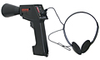
Description: The Model 9207 Ultrasonic Leak Detector (ULD) is a hand-held, high quality instrument that can locate costly leaks in a compressed air system. When a leak is present, an audible tone can be heard (with the use of the included earbuds) and the LED display will light. Testing the various
- Instrument Type: Condition Monitor / Fault Detector
- Form Factor: Portable / Hand Held / Mobile
- Features: Process Faults / Condition, Ultrasonic
-
Supplier: Danatronics Corporation
Description: ECHO FD is our portable ultrasonic flaw detector in the same field-proven case as our popular ECHO series. Our ECHO FD represents a breakthrough in terms of cost, size and ease of use for your everyday flaw detector. ECHO FD can even toggle from a flaw detector, corrosion or precision
- Features: Corrosion, Flaw Detection, Other, Pulsed Unit, Ultrasonic
- Form Factor: Portable / Hand Held / Mobile
-
Supplier: UE Systems, Inc.
Description: The Ultraprobe® 100 is the perfect fit for someone looking for cost-effective analog ultrasonic inspection technology. The Ultraprobe senses high frequency sounds produced by operating equipment, leaks and electrical discharges. It then electronically translates these signals by
- Operating Temperature: 32 to 120 F
- Local Interface: Analog Front Panel
- Display Type: Analog Meter or Indicator
- Leak Test Method: Ultrasonic Leak Detector
-
Supplier: Bacharach, Inc.
Description: 2100 is an ultra-versatile ultrasonic leak inspection system that can be used for both leak detection and mechanical PPM/inspection/troubleshooting. It is capable of finding leaks of any gas type, including refrigerants, air (compressed or vacuum) and nitrogen. The Tru Pointe® 2100 can also
- Display Type: Analog Meter or Indicator
- Local Interface: Digital Front Panel
- Output Options: Frequency / Modulated Frequency
- Leak Test Method: Ultrasonic Leak Detector











Find Suppliers by Category Top
Featured Products Top
-
 EXAIR’s Ultrasonic Leak Detector (ULD), a hand-held instrument engineered to help locate the source of costly leaks in a compressed air system, has received an upgrade in look and function. The EXAIR ULD can play a major role to identify and pinpoint costly leaks that often go undetected (read more)
Browse Leak Testing Equipment Datasheets for EXAIR -
time-consuming and impractical. Vacuum box testing is more accurate, creating a vacuum inside the hold to measure leaks by loss of vacuum. It is, however, expensive and requires the hold to be empty. Ultrasonic Testing (UT) is a quick and highly accurate leak detection test and is where Cygnus (read more)
Browse Leak Testing Equipment Datasheets for Cygnus Instruments Limited -
Ultrasonic Phased Array technology has revolutionized the way we perform bridge pin testing. Pins can now be ultrasonically tested using probes with multiple elements which allow the sound beams to be focused and transmitted through the pin at multiple angles and in a sweeping motion, thus (read more)
Browse Nondestructive Testing (NDT) Services Datasheets for NDE Professionals Inc. -
NDE Professionals offer Ultrasonic, a versatile inspection technique, used to test a variety of both metallic and nonmetallic products such as welds, forgings, plate, tubing, plastics, and ceramics (read more)
Browse Nondestructive Testing (NDT) Services Datasheets for NDE Professionals Inc. -
accurate thickness measurement and tightness verification to reduce failure risk, control maintenance costs and meet regulatory demands. Cygnus Instruments, a long-established leader in digital ultrasonic testing, offers a suite of solutions designed for these challenges. Its latest product (read more)
Browse Ultrasonic Instruments Datasheets for Cygnus Instruments Limited -
dangerous gas leaks. The Observer-i Detector features proven Gassonic ultrasonic technology including the patented Senssonic™ self-test function. This well-proven self-test checks the device’s electrical integrity and microphone every 15 minutes and ensures (read more)
Browse Gas Instruments Datasheets for MSA Safety -
to install flowmeters on its fire water lines. Challenge The customer used a competitor’s ultrasonic flowmeter on its main water injection line, which fed several produced water injection pumps. However, the flowmeter provided (read more)
Browse Flow Meters Datasheets for Panametrics -
The ultrasonic flowmeter has a measuring range of ±32 m/s. With an accuracy of ±1.5 % f.s. for a pipe diameter of DN ≥50, ±3.5 % f.s. for a pipe diameter of DN <50 and a reproducibility of ±0.5 % f.s., the ultrasonic flow meter is (read more)
Browse Ultrasonic Flow Meters Datasheets for PCE Instruments / PCE Americas Inc. -
Nondestructive Testing (NDT) is a form of engineering evaluation that detects and interprets flaws in materials, while causing no harm to the materials or structure under examination. It is an exacting science, with highly developed testing techniques. NPI is a dedicated, full (read more)
Browse Nondestructive Testing (NDT) Services Datasheets for NDE Professionals Inc. -
NPI's curriculum is designed for developing the well-rounded Inspector. This includes: QA, QC, and specific training in Non-Destructive Testing methods, Civil and Mechanical inspection. NPI trains qualified professionals for career opportunities in (read more)
Browse Instructional Seminars and Training Services Datasheets for NDE Professionals Inc.
Conduct Research Top
-
Ultrasonic Testing FAQs
Ultrasonic nondestructive testing, also known as ultrasonic NDT or simply UT, is a method of characterizing the thickness or internal structure of a test piece using high-frequency sound waves. The frequencies, or pitch, used for ultrasonic testing are many times higher than the limit of human
-
An Introduction to Phased Array Ultrasonic Testing
The NDT Overview series serves as a primer to the major NDT methods and techniques covered in ASNT's publications. This introduction to phased array ultrasonic testing is adapted from the second edition of Ultrasonic Testing Classroom Training Book, published by ASNT in 2018.
-
An Introduction to Ultrasonic Transducers for Nondestructive Testing
The high-frequency sound waves used for flaw detection and thickness gaging in ultrasonic nondestructive testing applications are generated and received by small probes called ultrasonic transducers. Transducers are the starting point for any ultrasonic test setup, and they come in a wide variety
-
Ultrasonic Flaw Detection
Of all the applications of industrial ultrasonic testing, flaw detection is the oldest and the most common. Since the 1940s, the laws of physics that govern the propagation of sound waves through solid materials have been used to detect hidden cracks, voids, porosity, and other internal
-
Polymer Developments for Ultrasonic Applications
Over the years, these elastomeric materials have been developed with a range of low acoustic velocities and relatively low attenuation. These materials are used as acoustic lenses in medical phased-array probes, refracting wedges and delay lines in industrial ultrasonic testing applications
-
Intro to Ultrasonic Phased Array
ultrasonic tests that include weld inspection, bond testing, thickness profiling, and in-service crack detection. This paper provides a brief introduction to how phased array systems work and how they can be employed in industrial ultrasonic nondestructive testing.
-
Using Infrared and Ultrasonic Technology in a Predictive Maintenance Program
implemented an ultrasonic bearing testing program to supplement infrared data and images, proving to the customer that testing for motor bearing failure is very worthwhile, and that, once again, the infrared pictures don't lie. Infrared is used to determine overall motor condition, and ultrasonic testing
-
Using the Total Focusing Method to Improve Phased Array Ultrasonic Imaging
The nondestructive testing (NDT) industry is experiencing an important technological advancement, as total focusing method (TFM) capable inspection devices are making their entry into market. The TFM approach represents a significant step forward for phased array ultrasonic testing (PAUT
-
Application Note: The Advantages of Broadband Ultrasonic Analysis During Leak Detection on Compressed Air Systems
Ultrasonic testing devices have long been established in the field of preventive maintenance to detect leaks on compressed air systems. These devices usually record a frequency range around 40 kHz. SONOTEC Ultraschallsensorik Halle GmbH is breaking new ground with the SONAPHONE ultrasonic testing
-
Ultrasonic and Advanced Methods for Nondestructive Testing and Material Characterization
Ultrasonic and Advanced Methods for Nondestructive Testing and Material Characterization. Placing emphasis on signal/image processing and pattern recognition of the signals acquired, this book examines the advantages of both industrial and medical ultrasound, and provides data in both signal
-
Application of Ultrasonic Cleaning
Many articles exist describing "how ultrasonic cleaning works". The goal of this article is to help develop an understanding of the various components that ensure good ultrasonic cleaning. First, establish a cleaning need, along with a determination as to how to measure the level of cleanliness
-
Ultrasonic Thickness Gaging
Ultrasonic thickness gaging is a widely used nondestructive test technique for measuring the thickness of a material from one side. It is fast, reliable, and versatile, and unlike a micrometer or caliper it requires access to only one side of the test piece. The first commercial ultrasonic gages
-
Miscellaneous Ultrasonic Applications
While a majority of the applications for ultrasonic nondestructive testing fall into a few well-known categories, the range of possibilities for the technology is large and new tests are constantly being developed and implemented. The applications section of the Olympus website is meant to cover
-
Ultrasonic Inspection of Oil & Gas Pipelines
A manufacturer of testing equipment for the oil refining industry needed a cable for ultrasonic inspection of oil and gas pipelines in Alaska to test for corrosion and cracks in the pipeline.
-
Sliding Sheet-Lattice Matrix for Ultrasonic Nondestructive Testing that Does Not Require Application of Liquids
Toshiba Corporation has developed a sliding sheet-lattice matrix (SSLM) for ultrasonic nondestructive testing in infrastructure maintenance and inspections. The developed SSLM does not require the application of a liquid couplant, such as the gel applied to human bodies for ultrasonic examinations
More Information Top
 Indicates content that may require registration and/or purchase.

-
Non-destructive material testing, ultrasonic testing
61 2.3 characterization and verification of the ultrasound testing equipment .