
Audio Amplifier Chips Information
Last revised: December 9, 2024
Reviewed by: Scott Orlosky, consulting engineer
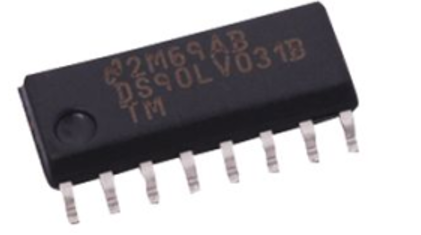
Audio amplifier chips are used in circuits used to process audio signals.
Operation Classes
Class A devices feature a design in which the output stage passes current at all times, even when the input stage is idle.
Class B devices do not pass current when the output device is idle.
Class AB audio amplifier chips combine Class A and Class B operation.
Class C designs are used for radio frequency (RF) transmission.
Class D designs have output devices that are switched on and off at least twice per cycle.
Class E, Class F, Class G, and Class H audio amplifier chips are also commonly available.
Package Types
- Single in-line package (SIP)
- Dual in-line package (DIP)
- Ceramic DIP (CDIP)
- Plastic DIP (PDIP)
- Small outline IC (SOIC)
- Shrink small outline package (SSOP)
- Small outline package (SOP)
- Chip scale or chip size package (CSP)
- Mini small outline plastic package (MSOP)
- Small outline transistor (SOT)
- Power small outline package (PSOP)
- Thin shrink small outline L-leaded package (TSSOP)
- Quarter size outline package (QSOP)
- Plastic leaded chip carrier (PLCC)
Specifications
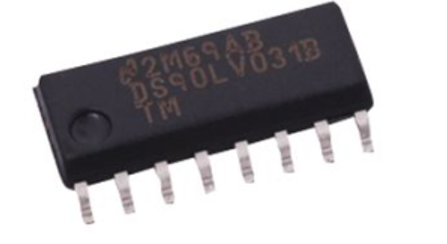
Audio amplifiers carry performance specifications such as operating temperature, output power, supply voltage, and supply current.
Total harmonic distortion (THD) is also an important consideration. With audio amplifier chips, THD is a measure of the purity of a signal. This value is defined as the ratio of the sum of the powers of harmonic components to the power of the fundamental.
Bandwidth, another important consideration, refers to the ability of an audio amplifier chip to provide a maximum output voltage swing with increasing frequency.
Features
Features are an important consideration when selecting audio amplifier chips. Some products have an embedded reference voltage or on-chip protection against electrostatic discharge (ESD). Others feature rail-to-rail output or rail-to-rail input.
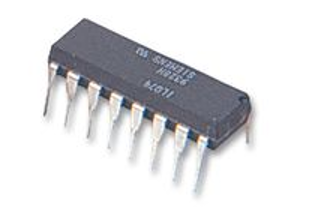
Single supply devices can operate with only one power supply. Audio amplifier chips with an embedded control circuit shut down the device when the temperature exceeds a predefined limit. Audio amplifier chips with embedded current limiters are also commonly available.
Standards
In Europe, ICs must meet the requirements of the Restriction of Hazardous Substances (RoHS) directive.
CTA-490 — This standard defines test conditions and test measurement procedures for determining various performance characteristics of single-channel and multi-channel power amplifiers, pre-amplifiers, integrated amplifiers, receivers, and tuner/pre-amplifiers that use AC mains power.
Audio Amplifier Chips FAQs
How do different operation classes affect the performance of audio amplifier chips?
Class D amplifiers are known for their high efficiency because the output devices are either fully on or fully off, minimizing power dissipation. This makes them ideal for battery-powered devices like mobile phones and laptops.
One downside is that the switching operation can generate noise, which can interfere with other electronic components, such as AM radios. However, advancements like increasing the switching frequency can mitigate this issue.
They are used in both low-power applications (e.g., hearing aids, mobile phones) and high-power applications (e.g., audio systems).
Class E amplifiers are designed for rectangular input pulses rather than sinusoidal audio waveforms, which can affect their suitability for certain audio applications.
Class F amplifiers are used for RF and microwave applications, which means they are not typically used for standard audio amplification.
Class G amplifiers change the power supply voltage from a lower level to a higher level when larger output swings are required. This can improve efficiency and reduce power consumption during low-level signals.
Class H amplifiers modulate the higher power supply voltage through the input signal, which can also improve efficiency and reduce power consumption.
Across all classes, performance specifications such as frequency response, output gain, power, number of channels, and nominal impedance are critical. Other important parameters include gain, bandwidth, efficiency, noise, output dynamic range, slew rate, rise time, settling time, ringing, overshoot, and stability
What are the noise mitigation techniques for Class D amplifiers?
One effective technique is to increase the switching frequency of the amplifier. By operating at a higher frequency, the noise generated by the switching operation can be pushed beyond the range of frequencies that are typically problematic for other electronic components.
Implementing filters can help to attenuate the high-frequency noise generated by the switching operation. These filters can be designed to target specific frequency ranges where noise is most problematic.
Smaller external filter components can be used effectively when the switching frequency is increased.
Designing the amplifier and its surrounding circuitry to meet stringent EMC requirements can help to minimize noise. This involves careful layout and shielding techniques to prevent noise from affecting other components.
Meeting standards such as the Comité International Spécial des Perturbations Radioélectriques (CISPR) 25 Class 5 EMC requirements ensures that the noise impact is minimized.
Using advanced modulation techniques can help to spread the noise spectrum and reduce its impact on specific frequency bands. This can be particularly useful in applications where certain frequency ranges are more sensitive to noise.
What are the filtering techniques used in Class D amplifiers?
Filtering techniques can mitigate high-frequency noise generated by the switching operation. For example, low-pass filters are commonly used to attenuate high-frequency noise while allowing the desired audio frequencies to pass through. These filters are typically placed at the output stage of the amplifier.
Filters used with Class D amplifiers usually consist of inductors and capacitors. The values of these components are chosen based on the switching frequency and the desired cutoff frequency.
Electromagnetic Interference (EMI) filters are designed to reduce the electromagnetic noise that can interfere with other electronic devices. These filters are essential for meeting stringent EMC (Electromagnetic Compatibility) requirements.
Advanced modulation techniques can help spread the noise spectrum, reducing its impact on specific frequency bands. This can be particularly useful in applications where certain frequency ranges are more sensitive to noise.
These techniques involve varying the switching frequency or using spread-spectrum modulation to distribute the noise over a wider range of frequencies, making it less noticeable.
By increasing the switching frequency, the noise generated by the switching operation can be pushed beyond the range of frequencies that are typically problematic for other electronic components.
What components are used in low-pass filters for Class D amplifiers?
- Inductors block high-frequency signals while allowing low-frequency signals to pass through.
- Capacitors pass high-frequency signals while blocking low-frequency signals.
- LC (Inductor/Capacitor) circuits combine inductors and capacitors to form a circuit that sets the cutoff frequency.
How do Class G and Class H amplifiers improve efficiency?
Class G and Class H amplifiers improve efficiency through dynamic adjustments to their power supply voltage. This reduces power consumption during different signal levels. Here is a detailed explanation of how each class achieves this.
Class G Amplifiers
Class G amplifiers improve efficiency by changing the power supply voltage from a lower level to a higher level when larger output swings are required.
This dynamic adjustment allows the amplifier to operate at a lower voltage during low-level signals, reducing power consumption. When higher output is needed, the voltage increases to accommodate the demand, ensuring efficient operation across a range of signal levels.
This approach minimizes power wasted during low-level signals, improving overall efficiency.
Class H Amplifiers
Class H amplifiers modulate the higher power supply voltage through the input signal.
By using this technique in response to the input signal, Class H amplifiers can reduce power consumption during periods of low signal demand. This modulation ensures that the amplifier only uses higher voltage when necessary, optimizing power usage.
Audio Amplifier Chips Media Gallery
References
Electronics360—Class D Auto Audio Amplifier Pushes Noise Beyond AM Band
GlobalSpec—Audio Power Amplifier Design Handbook, Fourth Edition
GlobalSpec—Audio Amplifiers and Preamplifiers
GlobalSpec—Power Operational Amplifiers
Image Credits:
1-Source Electronic Components