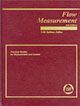
 The industry's most authoritative handbook on flow measurement provides a road map to the field of flow measurement. This best-seller discusses strategies for problem solving and puts the whole array of types of flowmeters at the reader's disposal. The text includes laminar flow elements, critical flowmeters, statistics for measurement, laboratory primary standards, and uncertainty in flow measurement. Emphasis is placed on the importance of accuracy in measurements and ways of ensuring accuracy and avoiding equipment damage through correct forecast of operating conditions, flowmeter selection, installation, calibration, and maintenance. Fundamental considerations such as mixed-phase flow, piping effects, and flow conditioning are examined at length. The problem of attaining a meaningful flow signal through linearization, compensation, and totalization is discussed. Join the thousands of engineers, technicians, managers, and salespeople that have found this reference text an invaluable resource.
 TABLE OF CONTENTS
 Chapter 1 - Why Measure Flow?
The audience for a book on the subject of flow measurement is relatively limited;
however, flow measurement is a common part of everyday life. For centuries,
domestic drinking water bills have been based upon flowmeter measurements, and
in ancient times flow measurement techniques were used in water clocks. More
recently, natural gas, fuel oil, gasoline, and potable water flowmeters have been
used to bill domestic customers.
While similar, industrial flowmeters exhibit some subtle differences when compared
to their utility counterparts, both measure flow. However, most utility flowmeters
totalize for internal billing and efficiency purposes, while most industrial
flowmeters measure flow rate for control, alarm, and indication purposes. Utility
flowmeters are optimized for many installations of a given application, while the
more expensive industrial flowmeters are of a more universal design that must be
carefully applied to each application.
Due to the vast number and types of fluids (such as liquids, gases, saturated
steam, superheated steam, wet steam, slurries, corrosives, and abrasives) that must
be measured in industrial processes and exposed to a myriad of operating and
ambient conditions (such as high and low pressures and temperatures), selection
of an industrial flowmeter can be a formidable challenge.
The magnitude of the challenge is illustrated by experience, whereby most
flowmeters will "work," but do not "work accurately." It is not uncommon to
encounter situations where the focus is on installing and maintaining a flowmeter
to be operational without even a passing thought to whether the measurement is
correct.
Why should there be a concern about measurement accuracy? The answer to
this question lies in the answer to the question posed at the onset: Why measure
flow? The importance of flow measurement accuracy reflects the importance
placed upon the primary purpose of the flow measurement.
Initially, in industry there was little interest in measuring flow, and flow measurements
were not considered. As time went on, the primary concern was whether or not
there was flow, and rudimentary flow measurement was considered. More recently,
interest is focused on obtaining reasonably accurate flow measurements to monitor
and improve process efficiency, quality, and safety. Investments are made in flowmeters
with the expectation of receiving a return that exceeds the costs associated with the
installation. Flowmeters that "work" but do not "work accurately" may not achieve their
potential return.