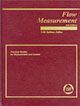
 The industry's most authoritative handbook on flow measurement provides a road map to the field of flow measurement. This best-seller discusses strategies for problem solving and puts the whole array of types of flowmeters at the reader's disposal. The text includes laminar flow elements, critical flowmeters, statistics for measurement, laboratory primary standards, and uncertainty in flow measurement. Emphasis is placed on the importance of accuracy in measurements and ways of ensuring accuracy and avoiding equipment damage through correct forecast of operating conditions, flowmeter selection, installation, calibration, and maintenance. Fundamental considerations such as mixed-phase flow, piping effects, and flow conditioning are examined at length. The problem of attaining a meaningful flow signal through linearization, compensation, and totalization is discussed. Join the thousands of engineers, technicians, managers, and salespeople that have found this reference text an invaluable resource.
 TABLE OF CONTENTS
 Chapter 4 - Fundamentals of Flow Measurement
Flowmetering is measuring matter in motion. An understanding of flow measurement
is based on an understanding of the medium and the characteristics of its
motion. Since with flow there is motion, the measurement of flow is a dynamic
measurement. In fact, flow measurement signals are described as "noisy," which is
a recognition of the dynamic, changing nature of flow. A quality measurement is
required under these conditions and can be made with an understanding of the
flowing medium, how that medium moves in piping, and the effect of the piping
on that motion.
Matter
In simplest terms, flowmetering is the measurement of matter in motion. Matter
occurs in three forms (phases): solid, liquid, and gas. Flow measurement is usually
the measurement of moving matter in the liquid phase or the gas phase. Collectively,
liquids and gases are known as fluids. However, it is not uncommon to have
flow of matter in more than one phase:
- Solids in liquid
- Gases in liquids
- Solids in gas
- Liquids in gas
- Solids and gases in liquid
- Solids and liquids in gas
Mixed Phases of Matter
Each multi-phase medium presents its own set of problems to being successfully
measured while in motion. The interest in the solid phase is only as it occurs
with either the liquid phase, as where the liquid is used as a vehicle to convey solids
(called slurries), or as it occurs with the gas phase, as in the pneumatic conveying
of solids. This interest extends to the size of the solid particles, their
distribution in the flow stream, and their mass relative to the fluid vehicle, that is,
whether the solid particles tend to float or sink in the flow stream. This interest
extends further to the nature of the solid particles, whether they are soft and amorphous,
hard and sharp-edged, or fibrous and the length of the fibers, etc. Further,
there is interest in solids beyond those fluids in which the liquid or gas is used to
convey solids from place to place. There is interest in those flow streams where
solids are a very small percent by volume of the total stream flow, in what usually
are called "dirty streams."