 The industry's most authoritative handbook on flow measurement provides a road map to the field of flow measurement. This best-seller discusses strategies for problem solving and puts the whole array of types of flowmeters at the reader's disposal. The text includes laminar flow elements, critical flowmeters, statistics for measurement, laboratory primary standards, and uncertainty in flow measurement. Emphasis is placed on the importance of accuracy in measurements and ways of ensuring accuracy and avoiding equipment damage through correct forecast of operating conditions, flowmeter selection, installation, calibration, and maintenance. Fundamental considerations such as mixed-phase flow, piping effects, and flow conditioning are examined at length. The problem of attaining a meaningful flow signal through linearization, compensation, and totalization is discussed. Join the thousands of engineers, technicians, managers, and salespeople that have found this reference text an invaluable resource.
 TABLE OF CONTENTS
 Flow Measurement
Chapter 3 - Physical Properties of Fluids: Electrical and Sonic Conductivity
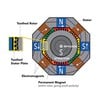
| This property is of importance when considering magnetic flowmeters. In most designs, the meter is able to detect flow only if the liquid is capable of conducting electricity to a small extent. Organic liquids such as oils and hydrocarbons are almost perfect insulators with no significant conductivity. In most cases they cannot be measured by magnetic meters. The minimum conductivity is always specified by the manufacturer, and it is very important to be sure the liquid is sufficiently conductive. A spot check for conductivity sometimes indicates that it is high enough, but it is quite possible that, at times, the material changes and the meter can fail to operate. | When conductivity is borderline, be sure to make a number of tests at different times - not just once or twice. |
The dimensional units for conductivity are usually given as micromhos/cm, micromhos/cm3, or siemens (S). Surprisingly, all these mean the same thing; they refer to the conductance between two plates, one cm2 in area and one centimeter apart, with the liquid in between them. Sometimes data is presented as "resistivity" rather than "conductivity." The two terms are merely reciprocals of each other, and the units of resistivity are usually ohms/cm3. | When choosing a magnetic meter to avoid flashing in a liquid with a low vapor pressure, don't forget to check its conductivity. |
Sonic Conductivity
Ultrasonic flowmeters depend on the conduction of sound through the liquid
being measured. When using the Doppler-type meters, the sound wave must
bounce off particles in the liquid, but it is not necessary that a sound wave traverse
the entire diameter of the pipe. When using time-of-flight meters, the liquid must
be relatively free of suspended material to allow passage of sound from one side
of the pipe to the other. This unique property of liquids is not easily expressed
quantitatively. Experience and specific testing of liquids can lead to the decision
of meter suitability.
© 2001 ISA