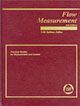
 The industry's most authoritative handbook on flow measurement provides a road map to the field of flow measurement. This best-seller discusses strategies for problem solving and puts the whole array of types of flowmeters at the reader's disposal. The text includes laminar flow elements, critical flowmeters, statistics for measurement, laboratory primary standards, and uncertainty in flow measurement. Emphasis is placed on the importance of accuracy in measurements and ways of ensuring accuracy and avoiding equipment damage through correct forecast of operating conditions, flowmeter selection, installation, calibration, and maintenance. Fundamental considerations such as mixed-phase flow, piping effects, and flow conditioning are examined at length. The problem of attaining a meaningful flow signal through linearization, compensation, and totalization is discussed. Join the thousands of engineers, technicians, managers, and salespeople that have found this reference text an invaluable resource.
 TABLE OF CONTENTS
 Chapter 27 - Laboratory Primary Standards
Meter manufacturers and users utilize laboratories with primary flow standards
to calibrate their working flowmeter standards. Such laboratory standards are
designed to have the lowest practical measurement uncertainty so that this high
accuracy can be passed on to the flowmeter being calibrated and subsequently to
the flowmeter application. Laboratory standards are used to assess flowmeter performance
under ideal conditions (generally field performance is not as good).
Presently, the uncertainty of laboratory standards is reported to be typically less
than 0.2% with a 95% level of confidence. All of the uncertainties herein will be
expressed as 95% level of confidence values unless otherwise stated. Laboratory
flow standards exist for liquid flows from approximately 0.1 g/min to 10,000 kg/
min and for gas flows from approximately 1x10⁻⁶ g/min to 100 kg/min. The low
uncertainty requirement generally means that these devices are used in tightly
controlled laboratory environments and are not portable. Laboratory flow standards
can be grouped into certain general categories, and examining their principles
and methods of operation is useful for those seeking to establish a flow
calibration laboratory or understand the laboratory calibration process. Laboratory
standards are typically custom-built devices, unique in design, but some commercially-
built laboratory standards are available.
Primary Standards A primary standard is defined as a device or object used as the reference in a | A primary standard is defined as a device or object used as the reference in a calibration that is acknowledged to be of the highest meteorological quality and that derives its measurement without reference to some other standard of the same quantity (Ref. 1). |