 The industry's most authoritative handbook on flow measurement provides a road map to the field of flow measurement. This best-seller discusses strategies for problem solving and puts the whole array of types of flowmeters at the reader's disposal. The text includes laminar flow elements, critical flowmeters, statistics for measurement, laboratory primary standards, and uncertainty in flow measurement. Emphasis is placed on the importance of accuracy in measurements and ways of ensuring accuracy and avoiding equipment damage through correct forecast of operating conditions, flowmeter selection, installation, calibration, and maintenance. Fundamental considerations such as mixed-phase flow, piping effects, and flow conditioning are examined at length. The problem of attaining a meaningful flow signal through linearization, compensation, and totalization is discussed. Join the thousands of engineers, technicians, managers, and salespeople that have found this reference text an invaluable resource.
 TABLE OF CONTENTS
 Chapter 3 - Physical Properties of Fluids: Specific Gravity
Specific gravity has two very different meanings, one for liquids and another
for gases. When applied to liquids, it is the ratio of the density of the fluid at one
specified temperature to the density of water at another specified temperature. As
such, specific gravity has no dimensional units and should always be accompanied
by two temperature values. Often, the water reference temperature is omitted, and
the reference temperature is assumed to be either 4°C or 60°F. Luckily, the density
of water is practically constant between those two values, so the omission usually
presents no problem. On the other hand, the fluid reference temperature should
always be included when using the term "specific gravity" for liquids.
Specific gravity is sometimes used to represent the density of liquids. This is
unfortunate because the two temperatures are often omitted. The implied meaning
probably is that the specific gravity is at flowmetering temperature and is referred
to water at 4°C, but one can never be certain. Specific gravity is a poor substitute
for density.
The specific gravity of a gas is the ratio of the density of the gas to the density
of air, both being measured at "standard" pressure and temperature. When stating
a gas specific gravity, the standard temperature is usually omitted. Standard conditions
are usually near ambient pressure and temperature, and the ratio of densities
is essentially unaffected, regardless of the ambient conditions chosen. Air at ambient
conditions acts as an ideal gas, as do many other gases. For these gases, the
specific gravity becomes the ratio of their molecular weight to that of air. If the
gas is not ideal at ambient conditions, this is no longer valid, but only slight differences
will be found.
| One interesting simplification arises because the density of water at 4°C is exactly 1.000 kg/l. This means that when specific gravity is referred to water at 4°C it is numerically equal to the liquid density in units of kg/l at its specified temperature. | The specific gravity of a gas is a constant value regardless of its pressure or temperature. |
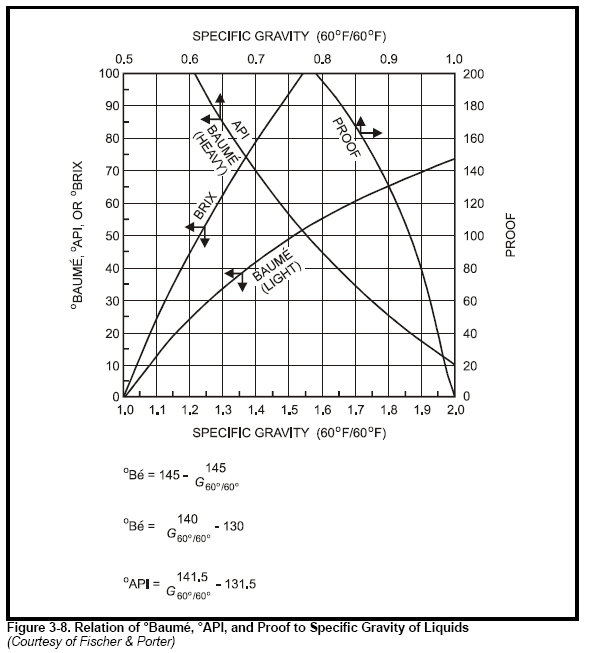
There are many other "relative" units similar to specific gravity. They are used
more to describe the concentration of various solutions than to describe their densities;
examples are: degrees Baumé, degrees Brix, degrees API proof. Figure3-8
shows how they relate to specific gravity.