The bio-pharmaceutical industry demands exacting detail in design, development,
operation, quality, and just about every other aspect of the business.
As such, there is a degree of specialty in most every field of endeavor
in this industry. This book was developed to try to accelerate the learning
process for the application of automation in bio-pharmaceuticals. The
authors' hope is that the content of this book will help scientists and engineers
continue to contribute to the manufacture of high-quality medicines
via improving process control and on-line availability of information
while reducing costs, cycle time, and process variability.
Some readers may come into this industry with previous automation
experience. Others may be in the bio-pharmaceutical industry, but have
limited automation knowledge. In either case, the authors strived to bring
the reader to a more thorough understanding of the topics.
This book is supplemented by a wealth of reference materials in the industry.
Each chapter contains a list of recommended reference materials.
 TABLE OF CONTENTS
 Chapter 3 - Applications
3.1 Automation Applications in Bio-pharmaceuticals
To properly automate a process, it is important to first understand the process
in some detail. In this section, we will explore most of the commonly
used unit operations in the bio-pharmaceutical industry. For each system,
we will first describe the process and the key challenges for automation.
Then, we will discuss typical instrumentation requirements. Finally, each
section will finish by describing control strategies to be applied to this unit
operation.
Process Description and Challenges
As discussed previously, all processes are different or unique in some way. It is
important that the engineer have a solid understanding of the requirements
of the specific process application before attempting to design a solution.
Typical Instrumentation Requirements
For each process, we discuss typical instrument requirements, including
any special needs for materials, physical configuration, location, and specific
sensor type.
Control Strategies
The discussion on control strategies covers a broad array of automation
and control strategy. This includes discussion of considerations for communications
with other processes, control sequences and logic, analog
control strategy with control loop configurations, special calculations
needed, and "tuneables," which are explained below.
Communications
For each process, we discuss the required communications with other
processes. For example, upstream and downstream process coordination
may be required to ensure accurate transfer of materials.
Sequences
The "Control Sequences" section discusses batch sequence automation
and typical logic issues. It may also point out special logic required for
protection of the process, personnel, or equipment.
Control Loops
In the "Control Loops" section we examine common control loops,
including a description of common cascade or ratio control strategies.
Calculations
For some processes, automated calculations may be required for typical
reporting. Where this is needed, we provide some suggestions for which
calculations are needed, and for methods to perform them.
Tuneables
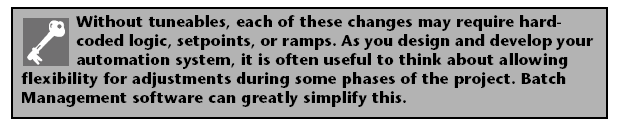
Process parameters may often need to be "tuned" during process development.
For example, CIP cycles may be optimized through adjustment of
flow rates, pressures, or cleaning times. Other reasons to make adjustments
with tuneables include:
- Process Development
- Product Development
- CIP/SIP Cycle Development
- Scale-Up
Tuneables may be adjusted, then locked down by the automation software
after completion of the development activity. Using a tuneables strategy
does require slightly more automation coding, but it can greatly reduce
the need for automation personnel to participate directly in the development
activities.
How Much Automation Do You Need?
To determine the level of automation required, you must have an extensive
understanding of both the process and the business. To illustrate this,
consider the following levels of automation:
- Fully manual operation. Manual gauges, and manual valves.
- Monitored manual operation. Manual valves, but some recording
of events and data. - Manual operation through a centralized control system. Data
Historization. - Small sequence operation. Individual sequences under control.
- Batch sequence operation.
- Flexible batch operation, producing many products with one set of
batch equipment.
As you increase levels of automation, you increase complexity, with a
resulting increase in cost and schedule, as well as in requirements for
technical expertise [3.1]. The decision for the level of automation is not to
be taken lightly.
Of course, the more complex the process is, the more value is brought by
automation. Automation can reduce staffing requirements, reduce cycle
times, and reduce risk of errors or quality and safety incidents. For example,
CIP and SIP of complex systems is almost always automated at least to
the level of "small sequence operation."
In the end, the decision of "how much automation?" is usually a group
decision for a project team. It is very important to openly describe and
discuss the appropriate level of automation, to ensure that there will not
be missed expectations.