The bio-pharmaceutical industry demands exacting detail in design, development,
operation, quality, and just about every other aspect of the business.
As such, there is a degree of specialty in most every field of endeavor
in this industry. This book was developed to try to accelerate the learning
process for the application of automation in bio-pharmaceuticals. The
authors' hope is that the content of this book will help scientists and engineers
continue to contribute to the manufacture of high-quality medicines
via improving process control and on-line availability of information
while reducing costs, cycle time, and process variability.
Some readers may come into this industry with previous automation
experience. Others may be in the bio-pharmaceutical industry, but have
limited automation knowledge. In either case, the authors strived to bring
the reader to a more thorough understanding of the topics.
This book is supplemented by a wealth of reference materials in the industry.
Each chapter contains a list of recommended reference materials.
 TABLE OF CONTENTS
 Chapter 3.13 - Centrifugation
Process Description and Challenges
In centrifugation, there is a separation of materials due to differences in
density. This may involve the separation of solids from liquids, or it may
be a liquid-liquid centrifugation, where you are separating two distinct
phases of liquid material.
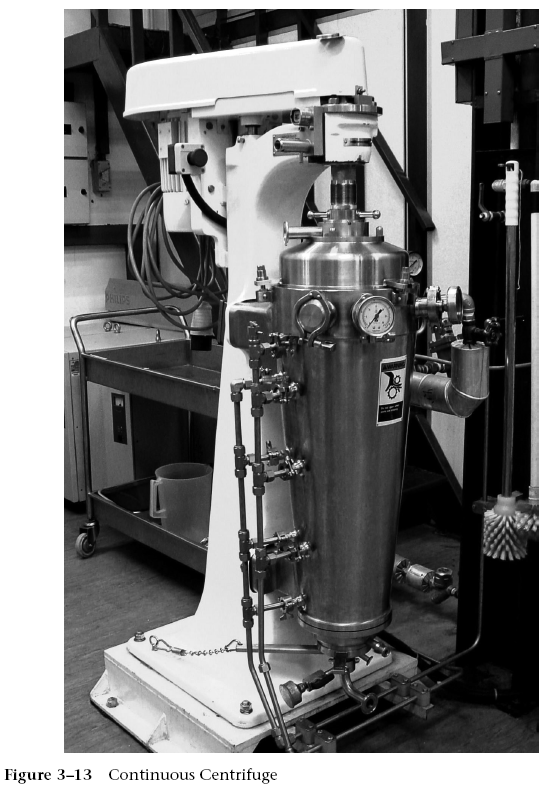
Centrifuges may be designed for batch or continuous operation. A diagram
of a continuous operation centrifuge is shown in Figure 3-13.
The critical parameters for centrifuge control are bowl speed and residence
time in the centrifuge bowl. These are generally controlled by
controlling the flow rate through the centrifuge. In a batch-style centrifuge,
bowl speed is the only parameter of concern.
Most industrial-scale centrifuges will come packaged with a control system
designed by the centrifuge vendor.
Operators will be in close attendance during centrifuge set-up, start-up,
and shut-down. Most centrifuges require manual assembly and disassembly,
so manual cleaning is often used instead of CIP. Some centrifuges support
SIP operation.
Centrifuge bowl speed may be over 10,000 rpm. This means you should
design appropriate safety shut-off systems, such as E-stops, that meet all
local codes and standards.
Typical Instrumentation Requirements
Centrifuge bowl speed is typically measured using a resolver or other noncontact
pick-up that counts spindle speed. The speed is sent directly to
the centrifuge drive controller. If the signal is being used or recorded elsewhere,
this can be done by daisy-chaining the speed signal to a recorder.
There are many secondary centrifuge measurements which do not directly
affect the process, but which must be monitored or controlled to ensure
reliable centrifuge operation. These may include lubrication pressure,
lubrication temperatures, and vibration sensors. Local instrumentation
can be used to satisfy the monitoring of lubrication and basic centrifuge
operation.
Control Strategies
Communications
The centrifuge controls are typically handled by a dedicated controller,
which is provided by the centrifuge manufacturer. For batch centrifuges,
little or no communication is needed. For continuous centrifuges, you
should allow for "ready to receive" signals to be passed from the centrifuge
to the upstream process.
Sequences
Centrifuge operation usually follows the following sequence, although
some variations exist, depending on process and centrifuge design:
- Pre-fill
- Ramp-up
- Fill
- Separation
- Ramp-down
- Harvest (batch systems)
During pre-fill, a buffer solution may be introduced. This allows the
machine to come up to speed without using actual product. During ramp-up,
the centrifuge is brought up to speed following a pre-designed ramp or
curve. Once at speed, the centrifuge is filled with product, and the separation
begins. Usually, the centrifuge is held at constant speed during the
entire separation.
Once separation is complete, the machine ramps down in speed, again
following a pre-defined curve or ramp. Finally, material can be harvested
from the centrifuge. Some centrifuges include automated scraper systems
that will engage to collect solid materials from the bowl walls at the end
of centrifugation. This reduces the manual intervention and reduces risk
of contamination.
Control Loops
Bowl speed is the primary control variable. Most of the bowl speed control
will be handled by a drive controller. Be sure to consult the process engineer
and the centrifuge manufacturer to determine configuration and
tuning parameters for the variable-speed drive.
Flow control to the centrifuge bowl may be best handled with a variable-
speed pump. A positive displacement pump, or peristaltic pump, may be
used to prevent the possibility of backflow during the dynamic operation
of the centrifuge.
Calculations
The gravitational force, or g-force, applied by the centrifuge drives the
separation. Calculation of g-force is relatively simple:

Tuneables and Other Notes
There are few tuneables for centrifuge operation. Ramp rates should be
developed directly from discussions with the centrifuge manufacturer and
operations.