The bio-pharmaceutical industry demands exacting detail in design, development,
operation, quality, and just about every other aspect of the business.
As such, there is a degree of specialty in most every field of endeavor
in this industry. This book was developed to try to accelerate the learning
process for the application of automation in bio-pharmaceuticals. The
authors' hope is that the content of this book will help scientists and engineers
continue to contribute to the manufacture of high-quality medicines
via improving process control and on-line availability of information
while reducing costs, cycle time, and process variability.
Some readers may come into this industry with previous automation
experience. Others may be in the bio-pharmaceutical industry, but have
limited automation knowledge. In either case, the authors strived to bring
the reader to a more thorough understanding of the topics.
This book is supplemented by a wealth of reference materials in the industry.
Each chapter contains a list of recommended reference materials.
 TABLE OF CONTENTS
 Chapter 3.12 - Precipitation
Process Description and Challenges
Precipitation processes involve precipitating solid materials from a generally
liquid steam. These processes can be very helpful in separating out
similar components from a complex mixture. Sometimes, the desired
product is in the precipitate, and sometimes it remains in solution while
you precipitate a waste component. In any case, precipitation reactions
must be tightly controlled to ensure success.
Temperature and concentration tolerances may be very tight. From a process
control standpoint, this may be very difficult to achieve. Process equipment
design plays a key role in ensuring that you can precisely control
temperature and concentration to such tight tolerances.
Some precipitation reactions are handled as fed-batch operations. This
may add a layer of complexity and coordination to the sequence controls.
Agitation also plays a critical role in the precipitation process. A variablespeed
mixer with speed feedback is recommended.
Finally, the use of highly volatile or explosive materials for the solute may
require explosion-proof designs.
Typical Instrumentation Requirements
Early in the design process, you must decide if the solvents used in this
process will require an explosion-proof design. If so, you must design the
entire room to conform to this requirement. All electrical equipment,
including motors, drives, instruments, PLCs, lighting, and cabinetry must
be carefully designed to meet these requirements. For more information
on cabinetry for explosion-proof environments, see Chapter 2.
Tight temperature control is critical to a successful precipitation. Choose
the location of temperature probes wisely. They should be immersed in
the precipitation medium and be representative of the bulk fluid temperature.
Choose high-quality, accurate probes.
For concentration controls, your best approach may be to meter the flow
rates of materials into the process. Getting on-line concentration measures
can be difficult at best. For flow metering, a good mass flow meter
will do the trick.
If it is possible to obtain an in-line measure of light transmittance or
absorption, you may be able to get a better look at the precipitation process.
Physically, this may be difficult. It may require a sampling system or
recirculation system. But it can provide invaluable insight into the process.
Control Strategies
A two-tiered approach to temperature control is recommended. First, all
materials added to the process should be temperature-controlled prior to
their introduction. This minimizes any local effects which could dissolve
precipitates back into the bulk solution. Then, vessel temperature controls
should maintain the bulk system at temperature.

Because the level in the vessel affects agitation and mixing, you will want
to consider variable-speed agitation. The speed of the agitator can be
linked to the level of the fluid in the vessel to ensure consistent control
operation.
Communications
As with other process areas, there must be communications for sending
and receiving of materials. A control processor is typically shared among
many of the process vessels in the purification area.
Sequences
The precipitation fluids may enter the vessel in a batch mode or fed-batch
mode. The product stream and the precipitation solute may be added at
different times, or simultaneously. Simultaneous addition is discussed
below, in the "Control Loops" section.
A typical fed-batch sequence is listed here:
- Add solute, ensure temperature control
- Slowly add precipitate
- Allow time for precipitation
- Dispense fluid from vessel
Transitions between each sequence can be based on time and completion
of addition.
Control Loops
The temperature control loops are the most critical. You should make sure
that the heating or cooling media used for the vessel is sufficiently independent
that the precipitation vessel will not be disturbed by upsets from
other parts of the process.
Making sure that each incoming stream has its own temperature control
loop will help to minimize temperature upsets.
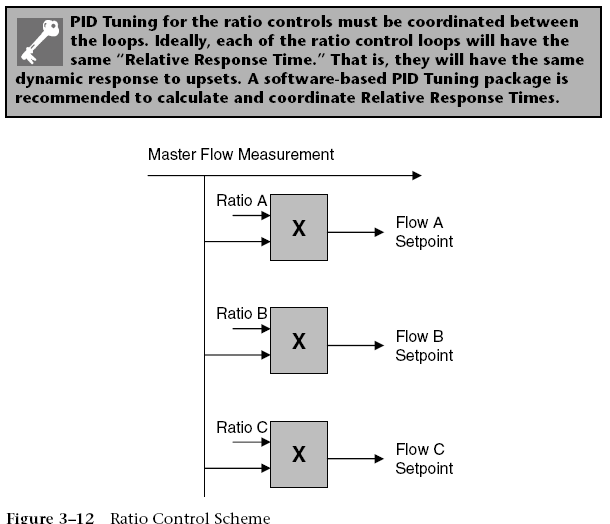
When adding multiple fluids simultaneously, a ratio control scheme is
recommended. This will ensure that a consistent proportion of materials
is added throughout the process cycle. A typical ratio control scheme is
shown in Figure 3-12.
Calculations
No additional calculations are recommended for precipitations.
Tuneables
During commissioning and scale-up activities, process engineers will want
to make adjustments to temperature setpoints, transition points, and concentration
ratios.